

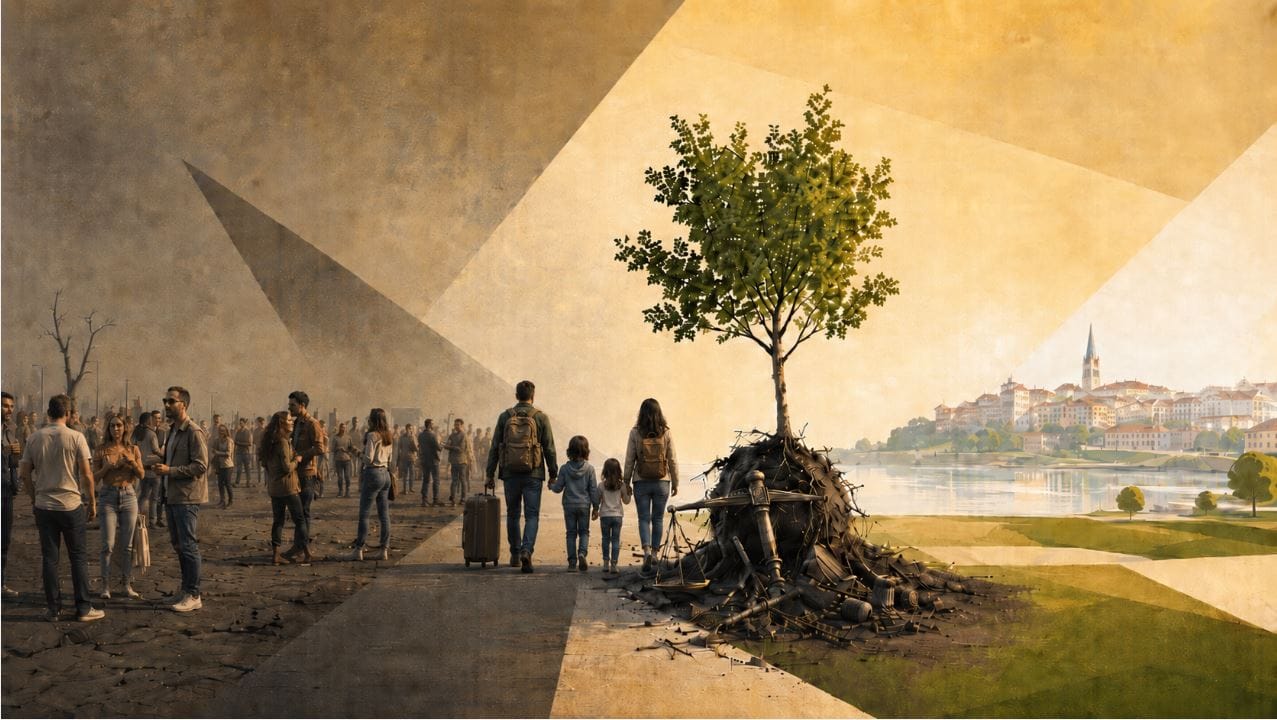
Like a tree uprooted and planted in other soil, the migrant arrives in a new country physically their age, yet starts again in language, status and past. The post-2016 wave of migration shows how this new beginning can be accelerated.
The Island, the 2005 film directed by Michael Bay and starring Ewan McGregor and Scarlett Johansson, is set in a dystopian future. In the film, a biotechnology company produces clones from the tissue of the ultra-rich of the day so that they can live longer and healthier lives.
These clones are born in artificial environments. Although their bodies are close to those of physically adult humans, they are portrayed as individuals whose mental and emotional development is deliberately kept limited. The aim is to raise extremely healthy individuals from whom organs can later be harvested for transplants. Every detail, from their diet to their sleep, from their daily routines to their physical movements, is therefore meticulously controlled. Their intellectual and emotional development, by contrast, is consciously restricted. The growth of the soul is dangerous, the deepening of thought undesirable. For the system, clones developing human emotions is an unacceptable risk.
They are told that a great epidemic has wiped out humanity in the outside world, and that they themselves live in a sterile and safe environment. From time to time they are told that they will be chosen by lottery and sent to a place called “the Island”, where they can live freely. In reality, being chosen means being taken into surgery for organ harvesting. Because they live in a tightly controlled system, the clones are prevented from realising this truth. Of course, as in every dystopian story, an exception emerges here too. What happens next is best left to those who want to watch the film.
The key analogy I want to draw attention to in this story is this: the clones are physically their age, but mentally and spiritually far behind it. I will come back to this point shortly.
A Tree Torn from Its Roots
I was struck when Can Dündar, during a programme, described migration while also emphasising his own position. The image he used was very striking. Dündar likened migration to a tree torn from its roots and planted in other soil.
For a tree uprooted somewhere in the world and planted in another region, the climate, rainfall, hours of sunshine, and the composition and minerals of the soil are completely different from where it grew. Its chance of taking hold in that new land is perhaps fifty per cent at best.
I think describing the phenomenon of migration in this way is apt.
Many parameters, such as language, culture, social structure, religion and status, change in the country of migration. Migrants often suffer a serious loss of status; they have no past in the country they move to and are forced, as it were, to rewrite their CV. If they hold a degree, they go through a recognition process, and they often have to learn a new language. Viewed only from this limited angle, the migrant’s situation can be compared to that of the clones in The Island.
Seen through both the film’s analogy and Can Dündar’s image, the migrant may be physically their age, but in every other respect falls far behind it. They try to hold on to life from an extremely disadvantaged position. Succeeding usually takes years, and the chance of failure is as high as the chance of success.
From the Old Migration to Today
In our recent history, the first examples of mass migration from Turkey to Western countries took place in the 1960s and 1970s. In this period Europe invited hundreds of thousands of people from countries with a labour surplus, such as Turkey, to close its labour shortage. Although these migrants initially helped to close the gap, blockages in integration led over the years to deepening problems.
Indeed, for the masses who came to Europe as labour migrants after the 1960s, learning the language took decades, and employment in skilled fields became possible only several generations later. Even today there are thousands of people in these countries who live without having learned the local language. Debates on social benefits and integration centred on these groups have, over time, become material for anti-immigrant rhetoric.
Lives Rebuilt
A large-scale migration movement from Turkey to the West came with the new regime practices introduced on 20 July 2016. In this process, hundreds of thousands of well-educated, career-holding and qualified people who were denied the right to a life in Turkey lost their jobs under the state of emergency and its decrees, and tens of thousands of them were imprisoned. According to Ministry of Justice figures, legal proceedings have been initiated against more than 720,000 people since 2016, and more than 110,000 have been placed in pre-trial detention. Tens of thousands, as far as they could, were forced to leave the country by crossing the Evros (Meriç) River or by the route via the Aegean islands.
In the countries they reached, these people fought to hold on to life again. They learned the language, tried to have their diplomas recognised, and those who faced recognition problems acquired new professions. In doing so, they came to see the countries they had reached as their own home. While carrying a longing for their homeland in the back of their minds, some as voluntary exiles, others by internalising the feeling and idea of “hijra” out of religious motivation, they made the countries they lived in their homeland.
This awareness and acceptance markedly accelerated and shortened their integration. A qualified segment of this new wave of migration achieved considerable adaptation and professional repositioning in periods as short as three to five years. Many of them, in step with the global digital transformation, obtained positions in these fields in their new countries and soon reached salaries and status similar to those they had in Turkey. Those who demonstrated their distinctiveness and skills rose to management positions within a few years; some founded companies, increasing their own income and contributing to the social and economic life of their countries. Within this group there are also examples of people who pay taxes, start businesses and create jobs.
In doing so, they have largely kept their ties with the people they left behind. For them, as long as those left behind have not found peace and prosperity, it is impossible to be truly happy and at peace themselves. Their efforts aim, on the one hand, to contribute to the social and economic life of the countries they live in and, on the other, to help improve the conditions of those left behind in Turkey.
From Loss to New Possibilities
Unfortunately, this process, which turned into a serious brain drain and loss of lifeblood for Turkey, meant that Western countries gained a trained workforce almost effortlessly.
Should justice prevail again in Turkey, this accumulated potential in the West could create important opportunities both for Turkey and Turkish society and for world peace. This community can help build strong bridges between Turkey and Western countries. It can strengthen the bonds of friendship between Turks and Western societies. These people, who combine Western values and Anatolian wisdom within Europe, can serve as a bridge for an alliance of civilisations, contrary to the rhetoric of a “clash of civilisations”, and become guarantors of peace and stability where they live.
Monthly · free
Compass of the Month
Once a month: five points from Europe’s security and migration agenda and the month’s PUGAT articles, in your inbox.
Newsletter sign-up opens soon.
Read next

What is PUGAT? A non-profit community publishing independent analysis from Europe on security, migration and society in Turkish, German and English.
Go to the homepage
