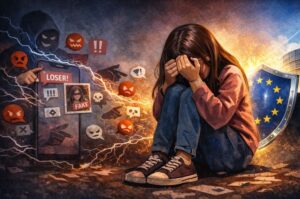
Cyberbullying and the EU’s Action Plan
Cyberbullying is no longer a debate about screen time but a public health issue. The EU’s new action plan aims to establish online dignity, privacy and safety as fundamental rights.

Topic
Cyber attacks, digital security, disinformation and the impact of artificial intelligence on security.
Cyberbullying is no longer a debate about screen time but a public health issue. The EU’s new action plan aims to establish online dignity, privacy and safety as fundamental rights.
The EU wants to be not just a player in AI but an ethical, human-centred leader. The “AI Continent Action Plan” announced in April 2025 is the latest link in a vision built since 2018.
The cost of cybercrime to the global economy is measured in trillions, and the question is no longer “will we be attacked?” but “when?”. The EU is responding with NIS2, DORA and the Cyber Resilience Act.
Germany does not leave cybersecurity to state institutions alone. The Alliance for Cyber Security (ACS), led by the BSI, brings companies, associations and NGOs together in a common network.
The EU’s Digital Markets Act designates the biggest technology companies, from Google to Meta, as “gatekeepers” and imposes new obligations on them. What will change for users?
Threats sent to American officers’ wives in the name of ISIS, the blackout of TV5 Monde, the leaks targeting WADA and the Democratic Party… Behind them all stands the same name: APT28, linked to Russian military intelligence.
Meetings, training and collaboration now happen on screen. But not every video-conferencing tool offers the same security. Zoom’s problems and the advantages of the open-source BigBlueButton.
The World Economic Forum’s Global Risks Report 2024 named the biggest risk of the next two years: AI-powered misinformation and disinformation. What does that mean in a year when three billion people go to the polls?
The task of intelligence is to see threats coming. AI is changing the balance in this race, and it brings new risks too, from fake images to the analytical capacity of terrorist organisations.
SIEM monitors, EDR detects; but what manages them all from one centre and responds to threats automatically? SOAR systems, the new conductors of cybersecurity teams.
Hours before Russia invaded Ukraine, it was cyberattacks, not tanks, that crossed the border first. DDoS attacks and data-wiping malware showed how the battlefield is shaped in modern war.
More than 5 billion people use social media, and in 2024 humanity will spend more than 500 million years on it in total. The global digital report sums up our internet habits in figures.
The shape of a protein can now be predicted almost instantly. AlphaFold’s solution to the protein folding problem has opened a new door for AI in developing drugs and vaccines.
Disinformation now spreads more through images and video than through text. The Bundeswehr’s AI-supported “Image Aware” project helps analysts by examining images on social media.
The Log4Shell vulnerability that emerged in December 2021 became one of the internet’s biggest security holes because of the widely used Log4j component. The article explains why it was so hard to close.
Topics
Latest articles
Series