

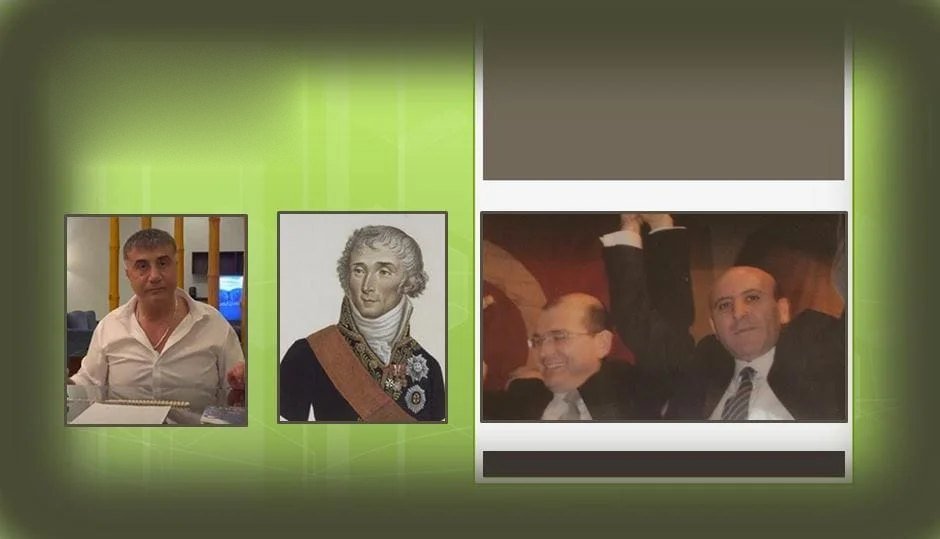
In his videos Sedat Peker likened Süleyman Soylu to Joseph Fouché, the scheming police minister of the French Revolution. The author explains the historical background and meaning of this allusion.
In his fourth video, Sedat Peker claimed that he had backed Soylu’s rise in the True Path Party (DYP, later renamed the Democrat Party) and had protected and watched over him. On this he said: “Come on, if you have any honour, speak. Didn’t you make me an enemy of Mr Berat? My relative Reşat Hacıfazlıoğlu, the one who organised everything for you. Come on, wasn’t it you, to get to the head of the DYP, they wouldn’t let you into the congresses. Pull it out of the old archives, there were those turbulent congresses. Long ago, look who was beside you, my friends, in their words my men, in my words my friends, my relatives. Come on, when you went in there, weren’t they beside you? …”
In his sixth video, Sedat Peker claimed that Soylu, after being elected Chairman of the Democrat Party by a margin of 14 votes, made his own man, the ex-convict Erdal Aras, a member of the party’s Central Executive Board, and also made Aras Mayor of Sancaktepe as a reward. Sedat Peker also stated that he had given financial support by sending money so that Soylu could be elected Chairman. He alleged that at the time Süleyman Soylu addressed Erdal Aras as “Erdal Baba”.
In the video in which he published his conversation with Hadi Özışık, Sedat Peker said that he and his relatives had been friends with Süleyman Soylu’s father for 30 years and had been investing in Soylu for 20 years, and used the words “We were coming back in April (2021), what is this, brother, everything was going to change in the country in April …”.
Again in his fourth video, on Süleyman Soylu, he said: “We have our clean Süleyman, our honourable Interior Minister. Now a friend called me and said, look, they’re coming down hard on Mr Süleyman, he’s going to say some things, the friend shouldn’t take it badly, he said. Fine, I said, no problem, normal. He was our ticket back to the country, he stole our dreams too, the ticket is gone… Anyway, our clean Süleyman tweeted on the first day. We’re tracking the leader of the crime organisation. Fine. Red notice… Fine, normal… Hey, when people attacked him a bit more, the next day, a filthy mafia crime organisation godfather? Mafia leader? now we’ll talk honestly… Three, Sedat Peker’s relative, we’re at a funeral, he sent word. There are phone signals, even if you say no it doesn’t matter, the phone signals are from the same place, we met at the funeral… Didn’t you say it? They’re preparing a file on Sedat Peker. I’ll let you know when there’s a dangerous situation, didn’t you say that?… Man, you’re a legend, I swear. If Joseph Fouché rose from the grave, Mehmet Ağar and the like are nothing, you are the indispensable man of the Turkey of the future. You, believe me, your star will always shine bright in this world. You’re an amazing man … “
In short, Sedat Peker claims that Süleyman Soylu, whom he and his relatives always supported materially and morally, for whom they did positive PR work and for whom they acted as intermediaries so that he would take important posts in the state (in a sense, infiltrating him into the state), was disloyal to them and turned his back on them. He also attributes the reason he has remained in exile, in his own words, for so long to Süleyman Soylu’s disloyalty.
In addition, Sedat Peker claims in his YouTube videos that he keeps in his own archive, with evidence, the crimes Interior Minister Süleyman Soylu committed together with his family and relatives, and what happened. To give a few examples:
- The FETÖ exchange. Obtaining money by frightening rich people with “there’s a file on you”, and binding bureaucrats to himself with this accusation, making them, so to speak, his servants and slaves,
- Following land and zoning procedures and earning unjust income from them,
- Removing names from criminal files in return for money,
- Having İbrahim Kalın followed, and
- The claims that the company owned by Süleyman Soylu, who used his office and position for material gain, suddenly grew.
Dear readers! The name Joseph Fouché mentioned in Sedat Peker’s fourth video reminded me of Stefan Zweig’s “Joseph Fouché: Portrait of a Politician”, which I read in 2001. To give us a small idea of why Sedat Peker compared Süleyman Soylu to Joseph Fouché, I want to speak briefly about Joseph Fouché’s life.
According to Stefan Zweig, he was the most powerful man of his time, yet the strangest of all time, unappreciated but feared just as much, reckless, clever and capable. Until Balzac saw him as an important character, he was regarded in the pages of history as an insignificant figure compared with his contemporaries Napoleon and Robespierre. Fouché was born in 1759 in Nantes, France, the child of a seafaring family. Because he was physically thin, frail, pale-looking and weak, his family did not want him to become a sailor and enrolled him in the church. Completing his education in the church, he became a teacher of mathematics and physics, and there he also learned the art of rhetoric to perfection. Because he was not the kind of character to bind himself irreversibly to anything, he did not take priestly vows. Throughout his church life he learned the techniques of being able to remain silent.
His face is always the same in the face of every event; he is silent and never has an outburst of anger. A poker face, in a sense. He has a very strong will; his gestures, facial expressions and tone of voice are always the same. In daily life he cares little for luxury, but he is excessively passionate and ambitious about power. Thanks to the personal development he gained in the church, in his later life neither threat nor anger will daunt him. Napoleon and Robespierre will shatter and scatter before this stone-hard, silent man. An addict of intrigue, Fouché takes tremendous pleasure in turmoil and in keeping files on people. But all his life he also manages to hide behind the profile of a serious, honest, dutiful official.
Always staying behind the scenes of events, he manages to bring leaders under his influence. In this way he always survives and becomes the sought-after man of every era. The Girondins fall, Fouché remains. The Jacobins fall, Fouché remains. The Directory, the Consulate, the Empire, the Kingdom and the Empire again collapse, but Fouché always survives. This chameleon, this turncoat, may be deeply religious today and the fiercest godless atheist tomorrow. One day he may be on the side of the moderates and another day on the side of the conservatives, and he can make other people believe this very easily. Before the French Revolution, universal concepts such as human rights and democracy had begun to be discussed everywhere, and politics had become the talk of the day. Fouché, wanting to turn the coming wind into an opportunity, threw off his cassock, left the church, founded a club and began making fiery speeches there. In Fouché’s view, a revolution never belongs to its pioneers, to those who started it, but to those who finish it and settle on it like spoils.
One of the important episodes in Fouché’s life is the coup carried out by Barras, one of the bourgeois he served during his first years of exile. In return for the services he rendered in this process, Barras made Fouché an envoy. Having carried out his ambassadorial duty successfully, Fouché was promoted and returned to France as Minister of Police (Interior Minister). In the later stages of his life, when their interests clashed, he was among those who sent into exile Barras, who had given him a chance to live and saved him from hunger and misery. And history witnessed one of the greatest acts of ingratitude.
During his time as Minister of Police, Fouché did not only do his own ministry’s work; he had all the other ministers, the assembly, the soldiers, everyone followed and kept files on them. He even had followed those who appointed him to the post. Clerks, secretaries, cooks, servants, fugitives and prostitutes in the bureaucracy, among the bourgeoisie and even in important businesses gathered information for him. Everyone in Napoleon’s inner circle, his servant, his bodyguards, even his mistress, was a source of information for him. He did not pass all the information he obtained on to the relevant people in the decision-making mechanism. Thanks to this information he built networks of bribery, played double and triple games, threatened people, plotted, sometimes foiled a plot he himself had hatched, and suddenly became the darling of those in power. For example, while threatening the royalists and anarchists at their meetings, he secretly supported them. Because he controlled the entire network of information, he became both dangerous and indispensable, and the most popular minister. With the information and documents in his hands, when their interests diverged, he would if necessary threaten even Napoleon. Even when Napoleon wanted to get rid of him, most of the time he did not dare to because of his interests. But he tried to overcome this impasse with various formulas.
Again thanks to this intelligence network, he grew his own money very quickly on the stock exchange and became the second-richest person in France. Although Napoleon did not trust Fouché, he gave him the title of Duke of Otranto in 1809 for his successes in his time.
In short, a life always on a knife’s edge, with successes stretching from poverty to a dukedom, with turncoat changes, exile and dangers… Joseph Fouché, who was priest-teacher, regicide, plunderer of churches, butcher of Lyon, communist, rich millionaire and Duke of Otranto. There is talk of a book of memoirs that Fouché, who spent the end of his life in loneliness, wrote or had written. But it is also said that Fouché was not the kind of man to share his secrets with others and that he wanted to be the only one to know everything. So there are also views that this book cannot be the real memoirs of Fouché, who wanted to be buried with his secrets.
Dear readers, why do you think Sedat Peker, who claims a 30-year acquaintance with his father and a 20-year investment in him, compared Süleyman Soylu to Joseph Fouché? And even made the comparison in the sense that, if Joseph Fouché rose from his grave, Soylu would make him look like a saint?
Monthly · free
Compass of the Month
PUGAT’s monthly newsletter.
Read next

What is PUGAT? A non-profit community publishing independent analysis from Europe on security, migration and society in Turkish, German and English.
Go to the homepage
