


The KDP and the PKK are two movements born of the idea of an independent Kurdish state whose paths later diverged. Operation Claw-Lock, launched in April 2022, has brought the balance in the Turkey–KDP–PKK triangle back onto the agenda.
It emerged with the idea of an independent Kurdish state. Its founding leader was backed by a large Kurdish population…
An opening like this immediately brings the PKK to mind. But I am not talking about the PKK. Mullah Mustafa Barzani began the struggle for an independent “Kurdistan” with the Kurdistan Democratic Party (KDP), which he founded in the 1940s, long before the PKK, and he was relatively successful. Thirty years after starting the armed struggle for an independent Kurdish state, Mustafa Barzani ended it in 1970 when the Iraqi state signed an agreement accepting the KDP’s demands. The foundations of the Kurdistan Regional Government of northern Iraq (KRG) were laid with this agreement. Let me open a parenthesis here to note that, in its official discourse, Turkey does not use the name “Kurdistan Regional Government of Iraq” (KRG) that appears in the Iraqi constitution.
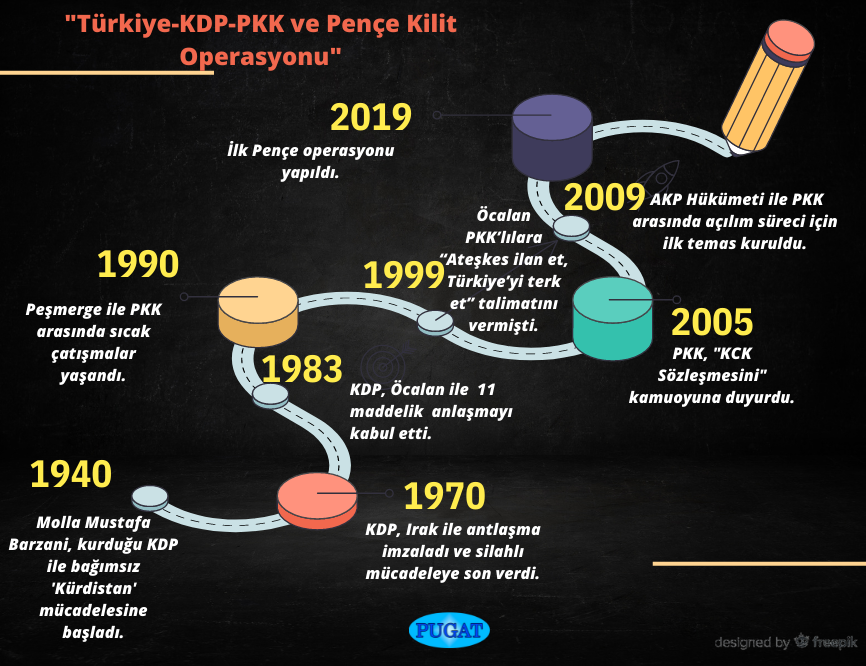
Before he died in 1979, Mustafa Barzani willed that his younger son Masoud Barzani should take over the leadership. Although Masoud Barzani had the right to have the final say as leader, he did not oppose the actions of his elder brother Idris Barzani. In 1983 Idris Barzani signed an 11-point agreement with Abdullah Öcalan on the PKK settling in Qandil, and the KDP accepted it. The PKK’s settlement in Qandil, and the tangle of problems with the KDP that at times escalated into clashes, emerged as the result of this equation.
The PKK–KDP Conflict
After settling in the Qandil mountains, the PKK gained a say in the wide area stretching from Duhok to Erbil and from there to Sulaymaniyah, which it calls the “Medya Defence Zones”. In this area, around 5,000 villages, along with some municipalities, came under PKK control.
From 1983 to 1990 Turkey carried out operations in northern Iraq under agreements reached with Saddam’s government, but after the region came under Kurdish control it needed the support of Kurdish organisations, above all the KDP. In the 1990s Masoud Barzani gave Turkey his full support, and there were fierce clashes between the Peshmerga and the PKK.
It can be said that the seeds of today’s tension were sown in those years.
On the eve of elections, Turkey launched a major operation together with the KDP in the Metina, Zap and Avashin-Basyan areas of northern Iraq, where the PKK terrorist organisation is based. The operation, named Claw-Lock, is a first in that it advances from south to north. After news of the operation was made public, comments came from many different quarters: “The PKK has not carried out attacks on Turkish soil for over a year, and Interior Minister Süleyman Soylu was saying that the number of PKK militants inside the country had fallen below 100. The political aim of this operation is to create an atmosphere of chaos and conflict before the elections, wear down the opposition through nationalist sentiment and drive HDP voters away from the Nation Alliance.”
When news of soldiers killed began to appear on the wires, a threatening video by PKK leader Duran Kalkan was released. In the video he spoke of “carrying the war into the cities and turning everywhere into a bloodbath”. With the terrorist incidents before the 7 June elections still fresh in people’s minds, the new developments gave the impression of a Turkey that someone wanted to drag back into the same atmosphere. On the other hand, the first Claw operation took place on 28 May 2019. In the last three years Turkey has carried out the Claw-2, Claw-3, Claw-Eagle, Claw-Tiger, Claw-Lightning and Claw-Thunderbolt operations. Forward outpost base areas have even been set up on northern Iraqi soil. In this respect, I believe the criticism that this was a surprise operation is unfounded.
So How Should We Read This Operation?
Let us look for the answer by going back a little. Turkey carried out its first cross-border operation against increasing attacks in Iraq in 1983, under an agreement with the Baathist regime of the time. Since then, according to official records, 19 large-scale operations have been carried out. The operations are generally seen to have been conducted in reaction to PKK attacks. After attacks in which we lost many soldiers, such as the Uludere-Taşdelen raid, the Dağlıca raid and the Aktütün raid, the Turkish Armed Forces carried out large-scale cross-border operations.
For instance, when the Taşdelen outpost, right on the border in Uludere, Şırnak, which I saw on the spot while serving there, was attacked by 500 PKK militants in 1992, the outpost commander, a first lieutenant, and 26 privates were killed, and Gendarmerie Private Aydın Şahin was abducted by the PKK. Footage of the attack was shown on television, newspapers heaped curses on the PKK in large type, the public reaction did not remain in words, demonstrations were held and a cross-border operation was carried out. Because a close relative of mine was also killed in these attacks around the same time, I clearly remember the public reaction. Although the PKK’s later attacks showed that the cross-border operations carried out up to that time had been ineffective in breaking the PKK’s strength, it can be said that they served, for a time, to let off public steam and prevent military losses from being questioned.
By 1999 Abdullah Öcalan had been handed over, and on 2 August 1999 Öcalan instructed the PKK: “Declare a ceasefire and leave Turkey.” As the PKK entered a period of disarray, things calmed down, and Turkey’s economic relations with the Kurdish administration in northern Iraq gathered momentum.
The New PKK After 2000
The 2000s were a period in which the PKK restructured and grew even stronger. The split of opinion and subsequent fragmentation seen in organisations that lose their leader did not happen in the PKK; it established an organisation suited to the new situation and quickly set up its chain of command. Indeed, the figure of “Öcalan in his single-person prison on İmralı Island” spread among young Kurds and increased recruitment to the PKK.
Resuming attacks in 2004, the PKK announced the “KCK Contract” in 2005 with the participation of 213 senior PKK leaders from the Middle East and Europe. The KCK Contract, a name we would hear a great deal in later years, was in fact a constitution. It added a new dimension to the methods of “strategic defence”, “strategic balance” and “strategic offensive” that the PKK had applied since its founding.
The perception that, through the KCK Contract, the PKK was moving towards statehood in the civilian sphere by unarmed means caused serious panic in the security bureaucracy. Intensive work was done on what the KCK was and what measures should be taken. Having gained new momentum in the civilian sphere with the KCK Contract, the PKK also stepped up its armed attacks from 2006 onwards.
Right after then Chief of General Staff Yaşar Büyükanıt’s remark “We are watching northern Iraq the way someone watches a house”, the Dağlıca raid took place in October 2007. In February 2008 Operation Sun was carried out in northern Iraq. The KDP remained neutral in this operation. In October 2008 came the Aktütün raid. Let me open a parenthesis here to note that in 2009 the AKP government established the first contacts with the PKK for the opening process.
After 2010, the new dynamics created by the Syrian civil war offered regional actors great advantages. It is the shared view of many experts that the PKK, one of these actors, made very good use of the advantageous situations that arose. While the opening process was continuing in Turkey, the PKK threw its full weight, with US support, behind the war against ISIS, to the extent that it shifted most of its militants in Turkey to Syria. For this reason, a strong view holds that for the PKK the opening process was a move to buy time.
The KDP, for its part, had begun to realise that it had missed its chance and that a new rival Kurdish administration had emerged in northern Syria. Moreover, as if the PYD, which has organic links with the PKK, being active in Rojava were not enough, the PKK’s seizure of control of the strategic Sinjar Mountain, which links the Kurdish regions on the Iraq–Syria border, was also unacceptable for the KDP. Because of its Syria policy, Turkey too strongly opposed the PKK and Iran’s paramilitary group Hashd al-Shaabi settling on Sinjar Mountain.
For the West, the priority is to transport the oil and natural gas extracted from the Kurdish regions westwards by safe routes, and for that to build a structure that can stand on its own feet.
With Russia’s invasion of Ukraine, the value of the oil and natural gas of the Kurdish regions has risen, like every option that could serve as an alternative to Russian gas. Looking at the overall picture in this context, I believe that, in line with an unnamed consensus suited to the common interests of the US, Turkey and Europe, the aim is to rein in the PKK and clear the way for the KDP. Although the US has periodically supported the PYD in line with its interests, it seems difficult for it to continue with the PYD, a more complex structure, against the KDP, with which it has acted for many years, and against Turkey, which is indispensable despite Erdoğan. Having the oil of Iraq and Syria under the control of a stable power is the main priority of the US and Europe.
The US, which is planning a status for the Kurds in Syria, wanting the KDP to be influential in the region can therefore be seen as the stronger possibility. The PKK’s reduction of the number of its attacks and intensification of its lobbying in recent years in order to be removed from the world’s terrorist lists can also be considered in this context.
The AKP and its partners, as always, fail to read the developments in the region. Because it will sell every blow struck against the PKK to the domestic public in the short term, the AKP is content with its situation and tends not to see the threats awaiting Turkey in the long term. (Update note, November 2026: Following Öcalan’s call in February 2025, the PKK announced its dissolution in May 2025. A disarmament process began in July 2025.)
Monthly · free
Compass of the Month
PUGAT’s monthly newsletter.
Read next


What is PUGAT? A non-profit community publishing independent analysis from Europe on security, migration and society in Turkish, German and English.
Go to the homepage
