

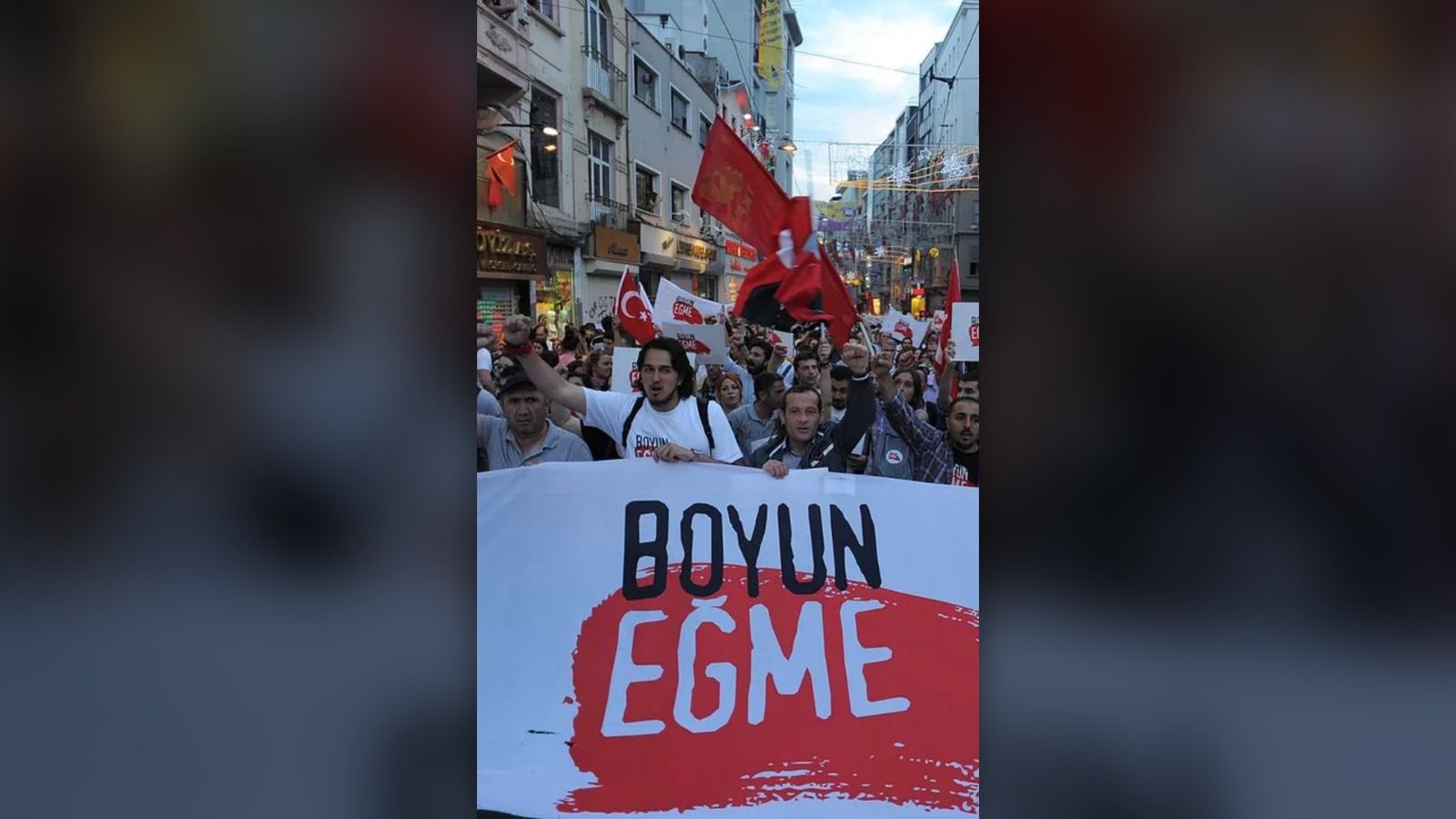
The Gezi Park protests at nine: from the history of Taksim to the course of the protests, the story of a popular movement in seven points.
Gezi Park was an area slated for transformation under the Taksim Pedestrianisation Project and the Artillery Barracks Project approved by the Istanbul Metropolitan Municipality in 2011. After its approval, the project became the target of criticism and protests over concerns that Gezi Park would be destroyed, Taksim Square would shrink and it could no longer be used as a venue for demonstrations.
The modernisation of Taksim Square began in the 1800s. The “Halil Pasha Artillery Barracks” was built in 1806. The square has witnessed many uprisings since then. The barracks was damaged during the 1909 revolt. In 1921 a stadium was built in its courtyard, and in 1940 the barracks was completely demolished and the area turned into a public square and park. Until 2013.
By 2013 it was back on the agenda with a new project designed by the country’s rulers. After the government announced that it would build a modern barracks complex including shops, restaurants, luxury residences and hotels, the events that began with protests by those opposing the uprooting of trees grew larger with harsh police intervention and turned into a general protest against government policies. Spreading across Türkiye and drawing wide coverage in the world press, the protests went down as one of the largest popular uprisings in the country’s history.
After the protests, Taksim Gezi Park, which went through a modern, concrete-heavy restoration and remained a park, returned to the agenda in 2019 with another, environmentally minded and green-focused restoration project after the Istanbul Metropolitan Municipality passed from the ruling party to the opposition. After this project was announced, the park was transferred to the Sultan Beyazıt Han-ı Veli Foundation and removed from the control of the Istanbul Metropolitan Municipality.

1. Is Gezi a Social Movement?
When sociologist Loïc Wacquant described Gezi in a talk at Boğaziçi University as a ‘revolt of the middle class rich in cultural capital’, a debate on the class composition of Gezi began in academic and left-wing circles. The AKP, for its part, always claimed that elites took part in the Gezi protests. Let us look at the results of a survey conducted on this question:
In December 2013, the SAMER Research Centre conducted a survey in Istanbul and İzmir. The survey was based on a random sample of 3,944 people representative of both provinces. The survey;
- showed that 16.27% of Istanbul’s population took part in the Gezi protests. Since the survey covered people over 18, this rate tells us that roughly 1.5 million people over 18 took part in the protests.
- 35.5% of Gezi protesters work in industry, construction, textiles, waste-paper collection, catering, transport and other irregular jobs, and 60% of this group earn less than 1,600 TL a month. 31.2% of protesters work in fields such as advertising, finance, academia, insurance, education, the public sector, culture, literature, health, NGOs and real estate. The average salary of this second group is 2,421 TL, and 50% earn less than 2,000 TL a month.
- Kurds make up 15.04% of the population of Istanbul and İzmir and 13.68% of Gezi protesters. 20.25% of those with a monthly income below 1,500 TL are Kurdish. 50% of the Kurds who joined Gezi have a monthly household income below 1,500 TL.
- The shares of those who support and oppose Gezi are almost equal: 41.4% of the public say they support it, 43.4% oppose it and 15.2% neither support nor oppose it. The average household income of Gezi supporters is 202 TL higher than that of its opponents.
Looking at the survey results, the thesis that only Turks, elites, trade unions or particular political views took part is wrong. That people from every section of society and every income level joined the Gezi protests shows that it was a social movement. Some of the photographs that became symbols of Gezi also support this.

These photographs are enough to show that Gezi was a popular movement. Unlike the representatives of three political views who cannot agree on a single idea even in parliament, different groups of football fans and people of different political views protested the government’s project together in the street.

2. Social Media as a Means of Communication in the Gezi Protests
With the development of technology, a digital culture has emerged and distances have shrunk. ‘Digital resistance’ has become even more effective than street protests. Some theorists have begun to discuss the idea of a digital public sphere. People have accordingly begun to object, revolt and resist in these spaces. People who start acting together on social media can organise faster and reach their goals more quickly.
That the Prime Minister himself called social media, which contributed greatly to organising people and spreading the protests across the country, a “menace” reveals its power. According to research by KONDA, 69% of Taksim Gezi Park protesters said they heard about the events through social media.
During the Gezi Park protests, groups were set up on Facebook to provide real-time information and calls to action. Alongside videos and photos of the protests, protesters exchanged information on how to protect themselves from pepper gas. Likewise, there were anti-Gezi groups and posts. The struggle took place not only in the streets but also on social media. Changing DNS settings and using VPNs to bypass internet restrictions and banned content became most widespread in this period.
The Gezi Park events increased Twitter use. While an average of 1.7 million tweets a day were sent in 2012, this figure rose by 470% to 8 million in 2013. On 30 May alone, 2 million tweets were sent. As the media reported the events from the government’s perspective, people turned increasingly to social media, using it not only to organise but also to access accurate, real-time information.

3. Statements by Political Parties
On the morning of 28 May, CHP and BDP MPs came to the square to stop the demolition work. The two parties’ positions did not change from the beginning of the events. The statements of political party leaders can give us a picture of the nine-year process. That Sırrı Süreyya Önder, who stood at the very front against the bulldozers, was later no longer seen in the square has always remained a question mark.
CHP leader Kılıçdaroğlu: “A politician does not humiliate his citizens; he elevates them. A politician does not exploit beliefs or religion. I have just given you an example of the words Recep Tayyip Erdoğan used to exploit religion and to smear bright young people. A politician holds to account those who violate the rights of others. But these people violate the rights of others and pat the violators on the back. That is their nature. A politician does not lie.” He expressed his support for the protesters by announcing that an MP would stand watch every day. On every anniversary of Gezi, he has maintained his position with messages of support.
MHP leader Bahçeli: “In the current process, it is beyond doubt that the events centred on Taksim Gezi Park have come to the fore as Türkiye’s most important issue. In this context, it can be seen that anxiety, fear and polarisation have sharpened and are drifting towards a point that is hard to manage. Prime Minister Erdoğan’s repellent, vindictive, needling, accusatory, temporising and ambivalent statements have invited a very dangerous atmosphere. It is understood that the Prime Minister, who approaches other social and political groups disrespectfully, immoderately and insensitively, and who does not hear or care about the expectations and demands piling up, has become the main source of instability.” Later, however, Bahçeli made similar statements in an even harsher tone, this time siding with Erdoğan and directing them at the other opposition parties.
Another issue that has constantly come up during and after the Gezi protests is the participation of Kurds. Although BDP MPs, representing the majority of the Kurdish political movement, were among the group that started the protests, they later withdrew their support. Responding to criticism of the BDP over Gezi, BDP Co-Chair Selahattin Demirtaş, who said his statements had been distorted, stated: “We did not distance ourselves from the Gezi resistance but from those who said, ‘Can we take this popular movement all the way to a military coup?’ We distanced ourselves from those who look to Ergenekon for help and those who call on the soldiers to take over. Let me say this to those who have distorted and spread my statement since day one: the Gezi resistance is a genuine popular resistance and a search for freedom. We stand right beside everyone who resists for freedom. The people at Gezi used to say, ‘We have learned the press’s distortions well’; apparently some of you still have not. Instead of listening to me, you watched penguins.” BDP leader Demirtaş, noting that if the people overthrew the government through revolution it would be legitimate, but if the military overthrew it by seizing power it would be illegitimate, added: “The revolution is made by the people, not by those who cannot take their eyes off the penguins. Example: the Rojava revolution.”
4. Snapshots Unique to Gezi
We shared above the most viral image of the Gezi protests, which upended every received wisdom. The image of three people with different political views, a Kemalist, an HDP supporter and someone making the grey wolf sign, in the same frame long remained in people’s memories. The woman in the red dress being sprayed with pepper gas stayed on the agenda for a long time. The standing man became one of the most passive yet most effective and resonant protests.

The woman in the black dress who stood in front of a water cannon truck (TOMA) with her arms open is remembered as one of the most inspiring acts.

The RedHack group is remembered as an internet phenomenon that drew the attention of millions throughout the Gezi protests with its tweets and the websites it hacked in support of Gezi.

Pot-and-pan protests took place across Türkiye, beginning when the media broadcast a penguin documentary during the Gezi Park events, in protest at most media outlets not covering the events. The musician Fazıl Say also showed his support by banging a pot at his concert.

The man reading a book took his place as a moment that summed up in a single frame the power of the book against violence and of art against rage.

5. Gezi in Numbers
The Gezi Park protests began on 28 May 2013.
The protests and events lasted 41 days.
Protests were held in 79 provinces, all except Bayburt and Bingöl.
According to official figures announced by then Interior Minister Muammer Güler, some 603 protests had taken place in 77 provinces as of 4 June.
The protesters’ tents in Gezi Park were removed by the police on 15 June 2013.
8 civilians and 2 members of the security forces lost their lives.
7,478 people were injured. 91 people suffered head injuries from gas canisters fired by the police. 10 people lost an eye and 1 person lost his spleen.
Cases were brought against 255 people.
30 foreign nationals were detained and 17 of them deported.
During the protests, 280 workplaces, 1 private home, 6 public buildings, 18 municipal buses, 207 private vehicles, 103 police vehicles, a police station, 11 AK Party offices and 280 ATMs were damaged or set on fire.
The media reported that 150,000 gas canisters were fired and 3,000 tonnes of water sprayed in 15 days, that three types of gas (OC, CS and CR) were used, and that capsules containing ‘bismuth’ were fired to mark protesters from a weapon called the FN-303, which can cause permanent damage to sensitive organs such as the eyes.
Borsa Istanbul lost 10.5% of its value on 3 June, and the decline continued throughout the events.
It was found that, because of the Gezi Park protests spreading across Türkiye, retail turnover and restaurant and cinema attendance fell by between 30% and 90%.
6. Manipulations and Lies
They drank alcohol in the mosque.
A newspaper published a photo of a beer can on a windowsill. The then Prime Minister claimed that alcohol had been drunk in a mosque. It turned out that the story was false and the beer can had been placed there afterwards.
When the mosque’s imam testified in the same vein, saying “I fear God, I cannot lie”, he was removed from his post.
On 5 June 2022, President Erdoğan claimed this time that mosques had been burned.
Kabataş
A story was published claiming that the daughter-in-law of an AKP official, walking with a pram in Kabataş, had been attacked by a group of 70 to 80 bare-chested people in bandanas and leather trousers, knocked to the ground and urinated on.
Participants in the Eurasia Marathon were presented as if they were joining the Gezi protests in an attempt to mobilise pro-government crowds.
Many stories not based on concrete facts, such as “if the protest lasts 48 hours the government will fall”, “the water cannon trucks are spraying chemicals”, “the police sprayed pepper gas at a dog” and “the protests are financed by Soros”, were circulated, especially on social media.
7. Erdoğan’s Insults and the Gezi Trial
Recently, in a speech in parliament about the Gezi Park protesters, President Erdoğan said: “They defiled the inside of the mosque. They are rotten, they are sluts.” Erdoğan had insulted the Gezi protesters many times before: looters, occupiers, terrorists, bandits, rotten ones, vandals, shameless ones, provocateurs, scoundrels…
The reason Erdoğan keeps up these insults is that he believes they keep his base energised. The political Islamist camp channels its accumulated anger towards other sections of society through Erdoğan. His insults find acceptance among his supporters. Knowing this very well, Erdoğan uses this style at every opportunity to set the domestic political agenda and to signal to his supporters.
The Gezi Park trial was concluded at the hearing on 25 April 2022. Businessman Osman Kavala was sentenced to aggravated life imprisonment; the other defendants, Mücella Yapıcı, Çiğdem Mater, Hakan Altınay, Mine Özerden, Can Atalay, Tayfun Kahraman and Yiğit Ali Ekmekçi, were each sentenced to 18 years in prison.
Update (November 2026): In September 2023 the Court of Cassation upheld Osman Kavala’s aggravated life sentence and the 18-year sentences of Mücella Yapıcı, Çiğdem Mater, Can Atalay and Tayfun Kahraman. The verdicts against Hakan Altınay, Mine Özerden and Yiğit Ali Ekmekçi were overturned. Can Atalay, elected to parliament in May 2023, was stripped of his seat in January 2024.
The conversion of the defendants’ earlier acquittal into life imprisonment is seen as part of Erdoğan’s pre-election plan.
Once again, groups wishing to make statements to commemorate the Gezi protests on their ninth anniversary were not allowed to do so. Through both security measures and harsh statements, the government keeps the reaction to the Gezi process constantly alive.
The Gezi protests are neither so simple that they can be seen as a matter of trees, nor so small that they can be described as an organised action joined by only one section of society. The reason they remain alive nine years later is the growing anger at the government. One should also always remember that Erdoğan likes to start the protests he can suppress.
Monthly · free
Compass of the Month
PUGAT’s monthly newsletter.
Read next

What is PUGAT? A non-profit community publishing independent analysis from Europe on security, migration and society in Turkish, German and English.
Go to the homepage
