

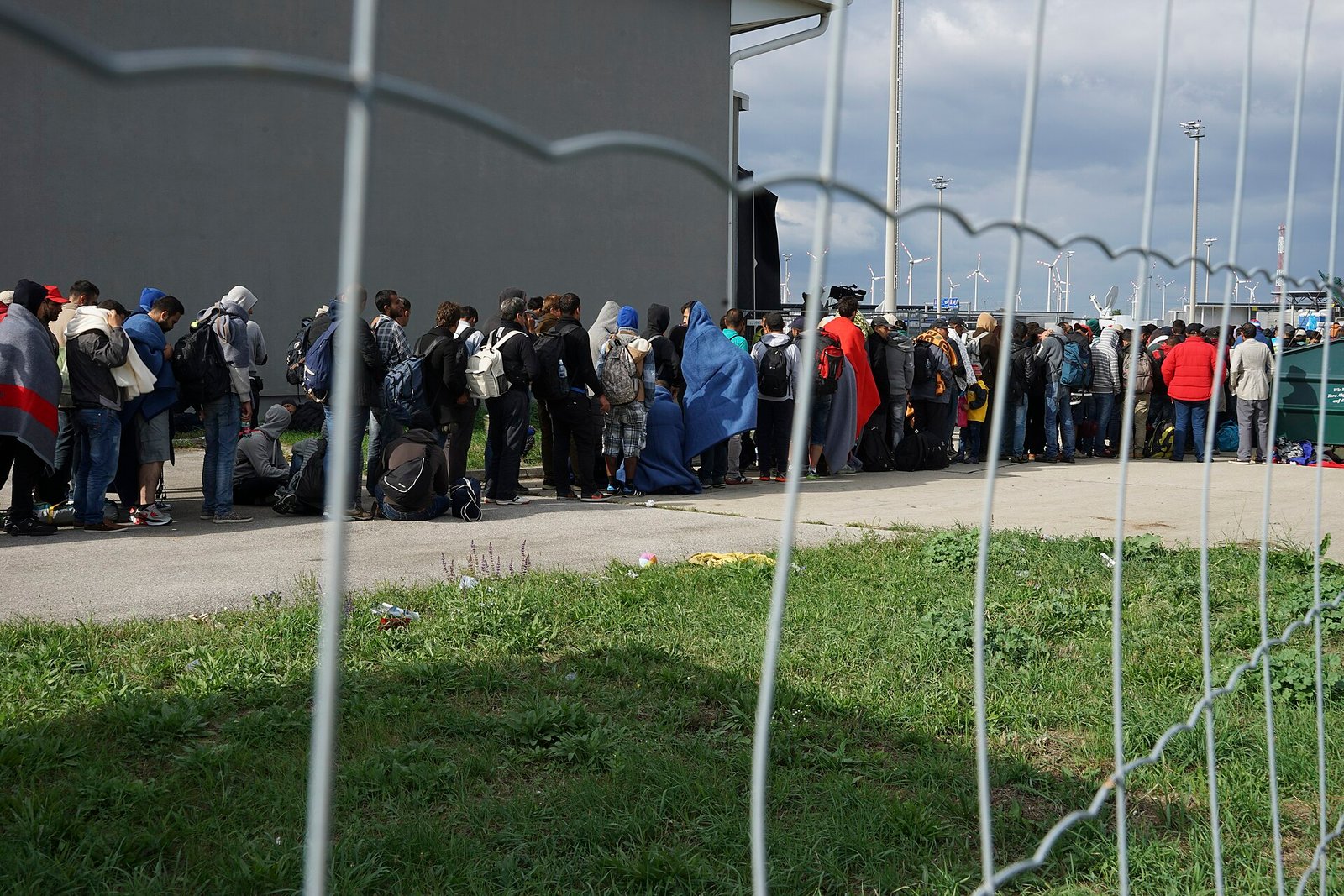
According to sociologist Zygmunt Bauman, many of the refugees coming to Europe are not hungry, poor people but people who have lost their former standing. This view calls for migration policies to be rethought.
Experience around the world has repeatedly shown that ideological approaches to migration and refugee policy open no door to solving the problems that arise. Migration is above all a sociological concept, and whichever aspect of the issue we take up, including its psychological, political, economic and cultural dimensions, we must listen carefully to the disciplines of sociology and the approaches of sociologists.

Zygmunt Bauman, one of the most important sociologists of recent times, who died on 9 January 2017, made very important assessments that also shed light on today’s events in an interview broadcast on Al Jazeera a few months before his death (23 July 2016). In this article, drawing on some of the points Bauman highlighted in the Al Jazeera interview, we offer some assessments of the problems facing countries that receive migrants.[i]
Are Refugees Poor People?
Bauman first turns the spotlight on the characteristics of the people who have migrated to Europe in recent years: “The refugees coming to Europe today are not hungry people migrating from lands where they lack bread and water. These refugees were people who were proud of where they lived and of their position in society.”
This accurate observation should be noted, above all by the countries exposed to migration. Otherwise the resulting picture of migration reduces all refugees to communities of asylum seekers made up of crowds resigned to hunger and misery, which is not a correct approach. This approach only serves the idea of contenting oneself with creating simple, barely adequate living spaces for these communities.
If policy-makers look at the issue merely as a population movement caused by economic deprivation, it would naturally be naive to expect a more comprehensive approach. For the refugees’ losses go far beyond meeting their need for nutrition and food. Bauman sums up the situation as follows: “In the present situation they are all asylum seekers. They have lost their homes, their position in society and everything they strove for all their lives. And in the end they came here (meaning Europe).”

A Cut-Throat World
It is certain that the gravity of the situation is far greater than is assumed. So:
- Do the leaders of countries have an awareness that has passed the test of sincerity?
- Are the bureaucrats dealing with migration policy able to present the drama and tragedy objectively?
- Can countries treat the item “migration”, written in bold on their agenda of problems awaiting solutions, as an issue that the state, society and refugees all face at every moment in the ordinary course of life?
These questions must be given clear and unambiguous positive answers. Otherwise the management of the problem is left to the initiative of communities, and refugees are abandoned to the street laws of the society in which they are forced to breathe and to which they are strangers, and to the ruthlessness of ideological agitation in those streets.
The Precariat: A Class Living with Insecurity
At this point Bauman uses the concept of the “precariat” to explain this important problem faced by refugees: “And what did they (the refugees) encounter here (in Europe)? The concept I have spoken of before, the ‘precariat’, the ‘insecure class’. Precariat means living in anxiety and worry. That is the most distinctive feature that defines the precariat. The concept derives from the French word précarité. To translate it hastily, the expression means slippery ground. It means there is no solid ground beneath your feet.” That a person or community forced to leave their country and migrate to another has no solid ground to stand on is a serious problem for personal and public safety, not only for themselves but also for the country they are in.
Of course it is not a sound approach to expect the individual refugee to overcome this problem alone. Through carefully crafted integration policies, governments must first enable refugees to free themselves psychologically from the mindset of the “insecure class”. Then centralised or decentralised policies should be developed so that they can gain a secure place in social life, through realistic approaches promising concrete solutions that governments will implement and follow up.
Coming to Terms with a New Reality
Since migration is one of the defining realities of today’s world, governments must not content themselves with short-term solutions that take this reality into account, but must produce policies that do not allow it to turn into an unstoppable tangle of problems in the long term. For the problem does not stem only from conditions in the place of arrival; refugees also arrive at their new settlements with their own agenda of individual (psychological, social or material) problems, and in ever greater numbers.
Bauman, too, puts his finger on this necessity with these words: “People are coming to Europe from countries such as Syria and Libya. And they bring bad news with them. They bring the threats they face from distant countries right into our back yard. Suddenly they appear right next to us, and we have no chance to ignore them and look away. We cannot do that because they are very conspicuous and there are very many of them. We cannot pretend they are not here. They are like the embodiment of all our anxieties, and they are becoming ever more visible. Only yesterday they were quite powerful and, I bet, happy people in their own countries. Just as we are here today. But look what has happened today. They have neither a home nor a livelihood; they are begging. In my view this shock is only the beginning. We are very far from digesting this situation and adapting to it.”
Yes, digesting this reality is not at all easy for governments or for local communities. It requires a process. This process needs to be managed very well by international organisations, governments, and central and local administrations.
The migrant problem that has arrived at countries’ doors can be seen as a threat, or as an opportunity. This will be shaped entirely by the policies governments develop on the issue.
Desperation
Whatever the reason, in the end the most characteristic feature of migration is that it contains “desperation”. People are forced to migrate because of the desperate situations they fall into in the homelands where they were born and raised or have long lived. Whether it arises from the eagerness of superpowers to use population movements as a war strategy or from the motivation to escape the oppression of dictators, in the end both those who migrate and those who host migrants shoulder both a material and a moral burden. In a manner of speaking, both sides suffer a grievance of their own.
It is obvious that competing over grievances and suffering will benefit no one. Moreover, it seems essential not to settle for the classic measures taken by governments as a way of overcoming the problems, but to develop hybrid policies that also take into account the new meanings the concept of migration has acquired. Perhaps at this point, instead of settling for standard official practices and integration measures dictated to refugees, priority and persistent attention should be given to developing hybrid measures to integrate into the new situation the local communities that are left to live side by side with refugees.
Indeed, the claims of discrimination between refugees, first whispered and now spoken aloud after the most recent wave of migration triggered by the Ukraine–Russia war, can be described as the footsteps of approaching security problems. It does not matter whether the claim of discrimination stems from the attitude of leaders, from the public’s point of view or from refugees’ mistaken assessments. In any case, under the dominance of prejudice, the issue can drift uncontrollably to a point between hospitality and demonisation.
Empathy, But How?
Labelling “the strangers at our door” as enemies or friends will make a solution harder, perhaps impossible. Instead, I would like to draw attention to the emphasis on “empathy” and record Bauman’s words here as an epilogue: “The limits of hospitality are not infinite. But nor are people’s thresholds for tolerating suffering. That is why we must try to empathise. But unfortunately here we have to say a big ‘but’. But there is no shortcut or instant solution for overcoming this situation. Dialogue is a very long process. It may take generations to build understanding. That is why we must prepare ourselves for the fact that very difficult times are approaching.”
[i] An abridged version of the interview with Turkish subtitles can be watched at this link.
Monthly · free
Compass of the Month
PUGAT’s monthly newsletter.
Read next


What is PUGAT? A non-profit community publishing independent analysis from Europe on security, migration and society in Turkish, German and English.
Go to the homepage
