

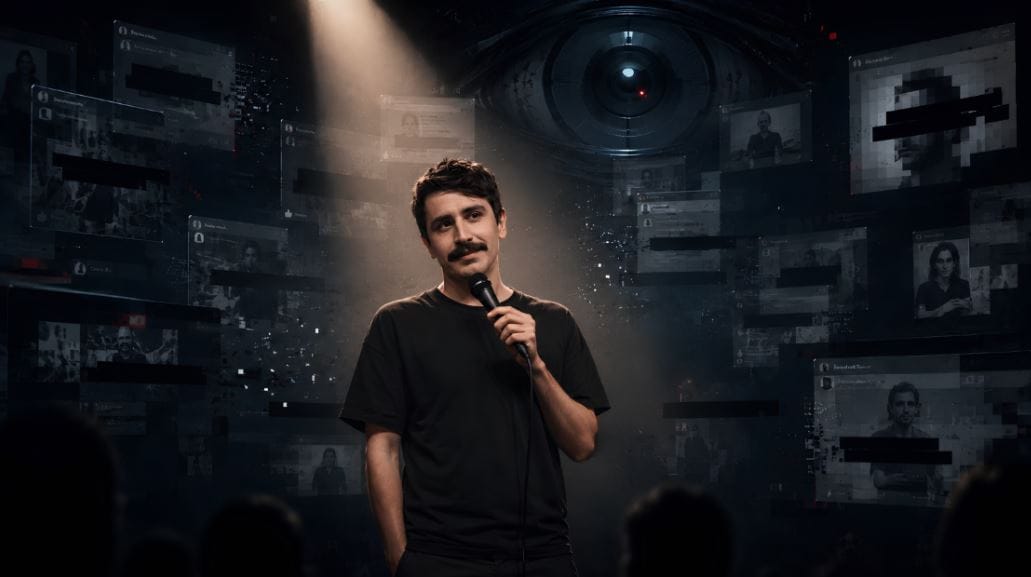
As the squares narrowed, opposition moved to the screen; now the screen is narrowing too. Article 8/A of Law No. 5651, the criminal judgeships of peace and the compliance of platforms are building a new order of censorship in the digital sphere.
On 24 June 2026, comedian Deniz Göktaş’s stand-up show “Ölü Deniz” (“Dead Sea”) was uploaded to YouTube and quickly drew millions of views. The show touches with humour on many current issues, from the politicians jailed in Silivri to the “absolute nullity” crisis in the CHP. Then the inevitable happened. Posts on X featuring clips from the show were blocked under Article 8/A of Law No. 5651 on grounds of “protecting national security and public order”. So this time it was decided that a comedian’s jokes had come to threaten a state’s national security.
In fact this is not a single incident but the latest link in a habit. The opposition that until yesterday was carried out in the streets, squares and coffeehouses has today largely moved to the screen. As physical public space shrank and shrank, people moved their objections to social media, independent news sites, podcasts and YouTube channels. Move they did, but on these digital channels too we experience the same censorship, the same surveillance and the same pressure, more intensely every day. And we are exposed to it not at random but through a specific legal mechanism.
Law No. 5651 and the Criminal Judgeships of Peace
The backbone of internet censorship in Turkey is Law No. 5651, and in particular its Article 8/A, introduced in 2015. The article allows content to be removed and access to be blocked on broad grounds such as national security, public order, the prevention of crime and the protection of life and property. As a rule, a criminal judge of peace issues the order. In urgent cases, the President of the Information and Communication Technologies Authority (BTK) may decide at the request of the Presidency or the relevant ministries; this decision must be submitted for judicial approval within twenty-four hours, and the judge rules within forty-eight hours. Access providers implement it within four hours. An account, a news story or a video that is visible in the morning becomes invisible by the evening.
The scale is not small. According to the EngelliWeb data of the Freedom of Expression Association (İFÖD), by the end of 2025 the number of websites and domain names blocked from Turkey had exceeded 1.5 million, with 875 different institutions and judgeships behind these decisions. In March and September 2025, social media and messaging platforms were throttled for a total of about 63 hours. After the Mayor of Istanbul Metropolitan Municipality was taken into custody in March 2025, 471 X accounts were blocked under Article 8/A between 19 March and 12 April. These accounts had more than 17 million followers in total and covered a broad spectrum, from politicians and journalists to student organisations and the women’s movement.
There is an ironic point here too: the Constitutional Court found the access-blocking provisions of Article 9, on violations of personal rights, disproportionate and annulled them. It has also repeatedly found serious shortcomings in the safeguards for freedom of expression under Article 8/A. Yet the criminal judgeships of peace continue to issue blocking orders just as quickly. In other words, not even a ruling of the highest court can stand in the way of censorship.
One Account, One Channel, One Decision
Looking at concrete examples makes the picture clear. In April 2026 the X account of the newspaper Cumhuriyet was blocked by a decision of a criminal judgeship of peace in Elazığ on grounds of “national security and public order”. The account of the Deputy Chair of the Labour Party (EMEP) was blocked under the same article right after a NATO protest he had attended. In June 2026 the X accounts of the LGBTİ+ Commission of the Human Rights Association (İHD), Mor Çatı and many women’s and rights organisations were again made invisible under 8/A.
When it comes to YouTube, the same logic applies. 454 videos by Grup Yorum published over the years, the channels of broadcasters with hundreds of thousands of subscribers, and the website and account of a satirical magazine over a cartoon were all blocked on the same template ground of “national security”. A tweet, or even a like, can today turn into an investigation on charges of “publicly disseminating misleading information” or “insulting the president”.
Notice that this list covers a wide spectrum, from a left-wing party to a satirical magazine, from a mainstream opposition newspaper to a rights organisation. Because the issue is no longer only “what is said”. The state also wants to bring “who says it” under its control. The censorship and blocking long justified with the “FETÖ” rhetoric now also targets groups of different political and ideological views.
Voices Abroad Are Not Safe Either
As pressure increased, many dissidents began to make their voices heard from abroad. At this point one might think: at least they can speak freely from there. Unfortunately, that is not the case. A social media account broadcasting from abroad is also blocked in Turkey, an investigation is opened against the content creator, and on returning to the country they may face measures such as a travel ban. A voice that crosses the border is silenced and suppressed so that it is not heard inside the country.
The most painful part is that, while all this is happening, no significant reaction arises from within Turkey. Often none arises at all. When an account is closed, those who do not belong to its owner’s political camp shrug. It is precisely this silence and lack of reaction that makes pressure and intimidation unstoppable. And so it has proved. The time when one could hope to gain anything from saying “Are you aware of the danger?” is long gone.
Silence and the Division into Camps
Frankly, when I see people acting as if we had never experienced this before, I rebel inwardly. When more than 125,000 public servants were dismissed and thousands of institutions were closed by emergency decree, there were those who shrugged it off with “they must know something” and “the state may punish its own, as a parent does”. That silence made every subsequent step easier. Now the same film is playing on the digital stage. Whoever stays silent today because the account being closed belongs to another camp finds no one at their side tomorrow when their own account is closed.
This is exactly what despotic rulers love most: dividing society into camps, squeezing each camp in turn, and targeting one while the others stay silent, then the next once that one falls silent. Saying “but he didn’t think like me” in the face of injustice makes the despot’s job easier. Rights are not divisible. Silencing a journalist, whatever the newspaper, is a blow to everyone’s right to information.
Yesterday’s Mistake, Today’s Lesson
There is one more subtlety. Some of those being censored today may have stayed silent yesterday when others were being silenced, and sometimes even applauded. Throwing this in their faces is of course very easy. You can always feel entitled to do so. Saying “How do you like the taste of it?” may even give a fleeting satisfaction.
But this is wrong. Rubbing a victim’s past mistake in their face today neither helps that person nor strengthens the common struggle. Virtue lies in being able to turn back from yesterday’s mistake. If someone has, however late, come to the point of saying “censorship is wrong”, that is something to welcome. Instead of celebrating that change, bringing up old sins again and again pushes people onto the defensive and narrows the ranks. Yet this fight can only be won as the ranks widen. There is no need to forget what happened yesterday. But constantly putting it on the table like a trump card is nothing other than doing the despot’s work of dividing us for him.
How Democratic Is the Digital Space?
Here we also have to face an uncomfortable question. Is the digital space as free as we think?
It is not. Social media platforms are not public property; they are private companies. Platforms that have opened offices in Turkey largely comply with the state’s blocking requests in the name of complying with the law. İFÖD calls this a “regime of digital obedience”: while appearing transparent in form, the platforms in practice become a compliant part of the state’s censorship apparatus. When X makes an account “invisible from Turkey”, the company that implements the decision takes its place in this equation as much as the judge who issued it.
Nor does the problem end with censorship. Algorithms feed polarisation, troll armies distort the agenda, and disinformation spreads as fast as information. In other words, the digital square is both pruned from outside by the state and shaped from within by commercial and manipulative dynamics. The place we thought was the cradle of freedom is in fact a rather fragile ground.
What Is to Be Done?
Dark as the picture is, there is no point in imposing helplessness on ourselves.
First, documenting rights violations. Independent monitoring projects such as EngelliWeb keep the data the state never discloses and make censorship visible. Even if this record is of no use today, it has the potential to become the basis for holding people to account tomorrow.
Second, rejecting the division into political camps. Taking a principled stand no matter whose account is closed. Once you say “he is not one of us”, sooner or later everyone’s turn comes.
Third, putting pressure on the platforms. It is not inevitable that social media companies bow to censorship. Organisations such as İFÖD, Human Rights Watch and ARTICLE 19 are calling on these companies to resist government censorship. The stronger this call becomes, the harder it will be for the companies to remain indifferent.
Fourth, digital literacy. Ways of circumventing censorship, communicating securely and verifying information can be learned and taught. The younger generation’s skill in this area is one of the points where repressive regimes struggle most. Because in the digital age it is almost impossible to stop the flow of information entirely.
Europe’s Responsibility
At this point some responsibilities also fall to European countries. There is of course a logic to putting interests first in relations between countries. Trade, migration, security: all are on the negotiating table. But when this calculation of interests turns into ignoring concrete losses of rights, another cost arises: emotional estrangement.
Here is how: a person of Turkish origin living in Europe sees an account being closed and a journalist being silenced in their homeland. Then they see that the country they live in does not say a single word about it. Because that country has a migration agreement or a defence deal under way with Ankara. Right there, that person is left alone twice: once because their homeland silenced them, and once because the country they live in stayed silent in the face of this pressure and censorship.
This double loneliness turns into a resentment that grows quietly. It makes integration harder, wears down social cohesion and deepens the feeling of “I could not belong here, and I could not stay there”. The psychology of being stuck in limbo has the potential to turn into a very deep trauma. As long as the country of residence stays silent about the discrimination and censorship its own resident faces in their homeland, this emotional estrangement grows day by day. So the issue is not just Turkey’s internal affair. For Europe to speak up against the injustice suffered in their homeland by someone who lives in a German town, pays taxes and sends their child to that country’s school is not only a debt of conscience but also an investment in its own social peace. Yes, every censorship decision can fit on a small page. A few articles, a stamp, a justification. Facing it is the blank page that thousands see on their screens at the same moment: “This content is not available in your country.” Everyone who sees that sentence realises they are being pushed towards becoming an untrustworthy citizen. Yet every page that is closed leaves behind one more reason not to stay silent.
Sources
- Freedom of Expression Association (İFÖD) – EngelliWeb ifade.org.tr
- Law No. 5651 mevzuat.gov.tr
- ARTICLE 19 article19.org
Monthly · free
Compass of the Month
PUGAT’s monthly newsletter.
Read next


What is PUGAT? A non-profit community publishing independent analysis from Europe on security, migration and society in Turkish, German and English.
Go to the homepage
