


Integration is not assimilation; keeping your identity does not stop you from taking part in the society you live in. Germany’s definition and suggestions from everyday life on what integration is and is not.
We can safely say that the success of people with a migration background in integrating also reduces negative attitudes towards foreigners. Because the aim of integration is to strengthen cohesion across society and to make living together, respect, mutual trust and a sense of belonging prevail.
The integration process requires cooperation between those who migrate and the host society. Even the smallest effort in this regard is very meaningful and worthy of appreciation. Because what matters is doing what is needed to live together in peace and calm, and making an effort to understand one another better.
Integration does not mean abandoning one’s own cultural values and identity or submitting to assimilation, and that is not what is expected of anyone. It is the most natural right of foreigners to preserve their cultural identity. Unfortunately, there are quite a few people who misunderstand this point and, sadly, who struggle between two different cultures.
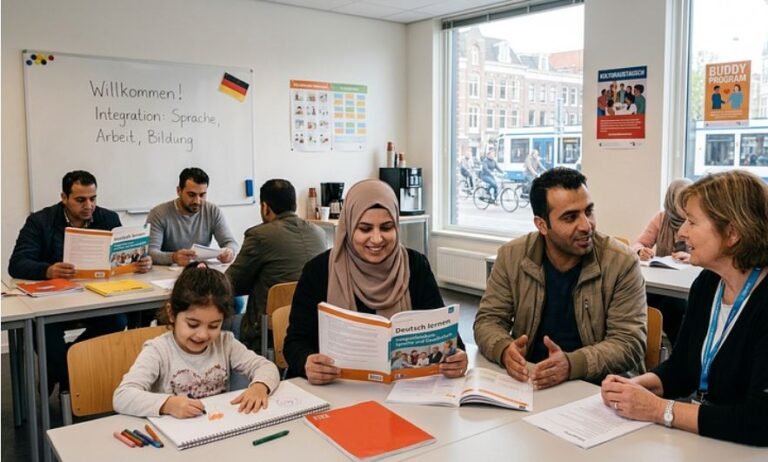
Germany, a good example that offers refugees and migrants remarkable opportunities for integration, defines integration and its goals and expectations for it through its Interior Ministry as follows:
“Integration is a long-term process that aims to include in society everyone who lives in Germany permanently and legally. The aim of the state’s integration policy is to give immigrants the chance to participate on a long-term basis in the same economic, social and societal spheres as the native population. Immigrants, for their part, are obliged to learn German and to know, respect and abide by the constitution and the laws. At the same time, immigrants should, where possible, be granted equal access to all areas of society.”
The German state says that through its extensive integration offers it seeks to enable equal opportunities and actual participation for immigrants in every area, above all social, economic and cultural life. As the precondition for all of this, it states clearly that people coming to Germany must learn German and learn about the country’s democratic order.
Overcoming Obstacles to Integration
As we said, successful integration means feeling that you belong to a community and developing a shared understanding of how we live together in society. That is why migration can become an opportunity for both sides only if both take the initiative. This will be possible if the majority society is willing to accept newcomers and if migrants respect the rules of the host country and make an effort to integrate.
At this point I would like to mention some of the things that can be done for integration personally, by civil society organisations and by states:
- Learning the language makes communication easier and opens the door to many opportunities.
- Remembering that we are part of society, taking part in various meetings and events organised locally by organisations, associations, foundations and the like, and interacting with our neighbours is very important for integration.
- Respecting the values of the society one lives in is only possible by understanding its culture and traditions well. Our efforts in this regard also strengthen our bond with people and with society.
- It should not be overlooked that people whose families have been torn apart and who are trying to rebuild their lives need support as they recover and heal from the traumas they have experienced. Foreigners could, for example, set up problem-solving centres by offering one another educational and psychological support in solving their problems.
- Employment opportunities can keep people from idleness or from illegal work. It is also very important that host states can offer opportunities that match people’s education and experience.
- For social integration, platforms should be created where foreigners can make their voices heard, or they should be allowed to have representatives in existing organisations.
- Those who produce hate speech on social media or other communication channels should be tackled through the law.
- Media organisations should report accurately and impartially and avoid discriminatory content that could disturb social peace. Individuals, too, should demand this.
- Diversity should be encouraged at every level of society and equal opportunity ensured in practice.
- Education against ideological radicalisation, the enemy of integration, should be provided both in all places of worship and in schools.
- In fact, every stakeholder in society has a role to play in preventing radicalisation. Individuals and families, the smallest building blocks of society, should protect themselves, their families and their children from toxic populist, separatist and extremist approaches. Separatist and radical rhetoric that spreads uncontrollably like a virus through the internet and social media and threatens peace, unity and togetherness should also be stopped through legal means, since it constitutes a crime.
Empathy and Taking the Initiative
I find it very important to try to correct foreigners’ negative behaviour within the framework of person-to-person relations, with reasonable language and methods. Let me explain what I mean through two incidents I experienced:
Once, in a shop, I followed someone who had thrown their rubbish on the floor and told them they had dropped it, and the person picked it up and thanked me, embarrassed.
Another day, a man sitting next to me on the tram was making a loud video call and disturbing everyone. A young man sitting beside us warned him, and they started arguing. The young foreigner who had been disturbing everyone turned to me and asked, embarrassed, whether I was really bothered too. He ended the call. When we told him that making the call on speaker and out loud bothered us, he apologised, and at that moment both he and we realised that this young man had not even been aware that he was disturbing everyone.
So what is expected of us in the face of negative behaviour is not to accept everything and swallow it in silence, but to make a sincere contribution to removing the problem. After all, one can only take one’s hat off to the courage to call a wrong a wrong.
Who Wins?
We can stress again that countries that read and understand the reality of migration correctly and turn it into an opportunity in the best way will make extraordinary gains. This can be understood better even through the examples of Germany, a relatively successful case, and Turkey, which we can hardly call successful. In 2022 alone, 23,938 Turkish citizens are reported to have applied for asylum in Germany alone.
We also know that there are foreigners who have somehow lived in Turkey until now but have had to leave, or want to leave, because of rising xenophobia, insecurity and a sense of injustice. Indeed, the rising asylum figures in the statistics show that Syrians and Afghans who no longer consider Turkey a safe country for them are also leaving.
For example, I had listened, and been very surprised, as two newly graduated Afghan doctors who had studied in Turkey on state scholarships told me how they left for Europe as soon as they had the chance. I had also listened to two young Syrians who had worked in Istanbul for years explain that they had decided to leave because they no longer felt safe for themselves and their families. (We can discuss these in another article.)
It is obvious how Germany’s successful integration practices have increased the country’s attractiveness for foreign, skilled and young workers. It is not at all hard to predict today that Turkey, which lacks tangible and sufficient support for the integration of foreigners, will face very serious crises in the coming years because of the migrants it has lost or will lose, on top of the problems it already faces from its existing brain drain.
A Wish
I would like to end this series of articles, compiled from my impressions and experiences in recent years, with a wish.
I hope that, as should be the case in many areas, we can build a just and peaceful future for our children and future generations through a collective and systematic effort, all together. To do so, we must always invest, with tolerance, in humanity, the common good and the culture of living together. What matters is not to make problems bigger but, on the contrary, to contribute to solving them. And in that effort, what we must focus on is not our differences but what we have in common!
Sources
- Federal Ministry of the Interior – Integration bmi.bund.de
- BAMF – Integration bamf.de
Monthly · free
Compass of the Month
Once a month: five points from Europe’s security and migration agenda and the month’s PUGAT articles, in your inbox.
Newsletter sign-up opens soon.
Read next


What is PUGAT? A non-profit community publishing independent analysis from Europe on security, migration and society in Turkish, German and English.
Go to the homepage
