


The World Economic Forum’s Global Risks Report 2024 named the biggest risk of the next two years: AI-powered misinformation and disinformation. What does that mean in a year when three billion people go to the polls?
The Global Risks Report has been published for almost twenty years and is based on data drawn from the answers that large numbers of global risk experts, policymakers and industry leaders around the world give to the “Global Risks Perception Survey”. More than 1,400 experts took part in the survey conducted in September 2023 for this year’s report.
The report defines a “global risk” as the possibility of an event or condition which, if it occurs, would negatively affect the economy, population or natural resources worldwide.
One of this year’s key findings is that cooperation on urgent global problems may increasingly decline, and the report stresses the need to develop new approaches and solutions to deal with these risks.
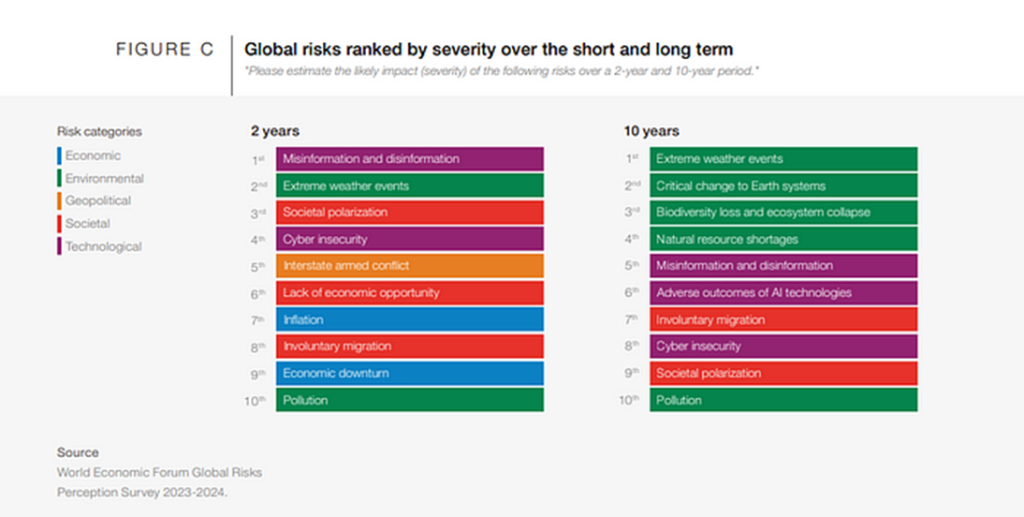
When the experts surveyed were asked about the risks they expect over two-year and ten-year horizons, “misinformation and disinformation” emerges as the biggest risk facing the world over the next two years.
According to the Global Risks Perception Survey, 54 per cent of respondents expect some instability and a moderate risk of global catastrophes, while 30 per cent expect even more turbulent conditions.
For about two-thirds of respondents, the next ten years will be gloomier than ever.
“Misinformation and disinformation” tops the list of risks facing the world over the next two years, with “extreme weather events” and “societal polarisation” in second and third place.
“Cyber insecurity”, eighth in last year’s report, is rated in this year’s report as the fourth most important risk facing the world over the next two years.
In a list where disinformation and societal polarisation take first and third place, the risk of “interstate armed conflict”, which can be seen as a possible result of these two risk factors occurring together, has, unlike in previous years, entered the list in fifth place this year.
Which Global Risks Are Expected in 2024?
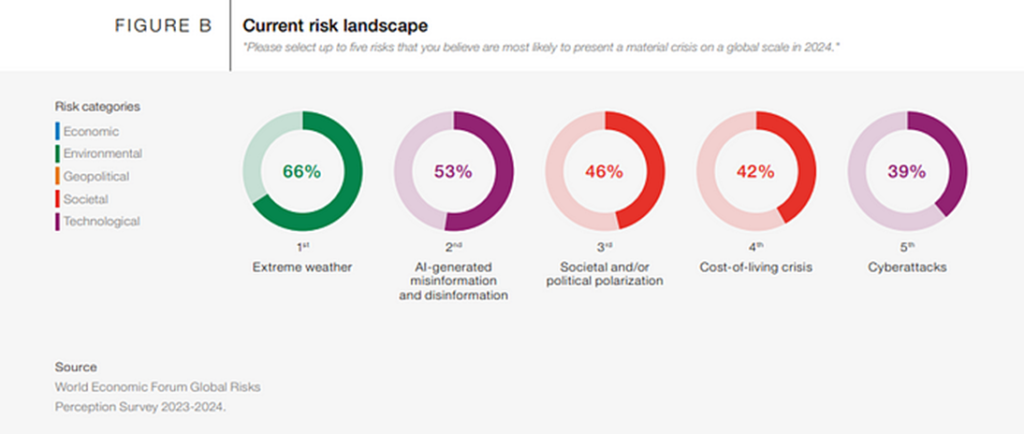
The five risks most likely to cause a material crisis on a global scale in 2024 are ranked as follows.
Extreme weather events
AI-generated misinformation and disinformation
Societal and/or political polarisation
Cost-of-living crisis
Cyberattacks
The Rise of the Disinformation Risk
Misinformation and disinformation, which ranked sixteenth among the risks expected to emerge in the short term in last year’s report, climbed rapidly this year to take first place.
Behind this rise are thought to be the elections approaching around the world and the misuse of fast-advancing artificial intelligence technology.
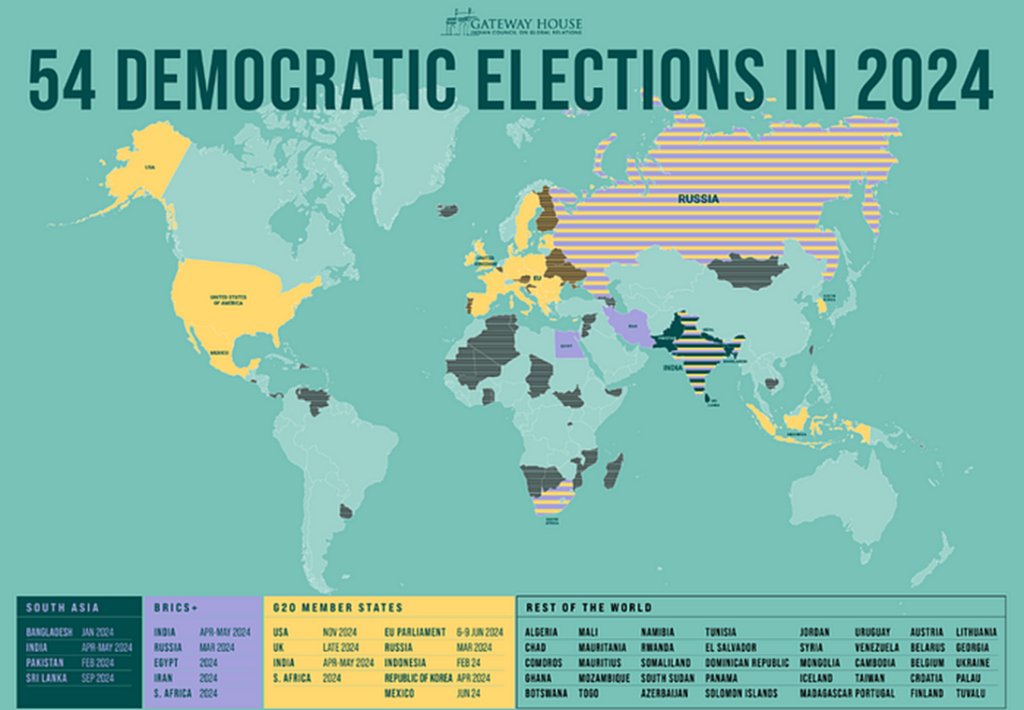
The fact that in 2024 there are parliamentary or presidential election races in more than 50 countries, directly affecting around three billion people, strengthens the likelihood that disinformation will have a global impact in this year’s risk outlook.
The report sums this up as follows:
Misinformation and disinformation could radically disrupt electoral processes in several economies over the next two years.
- Growing distrust of information, as well as of media and governments as sources, will deepen polarised views.
- Linked to this, there is a risk of entering a vicious circle that could trigger civil unrest and possibly conflict.
- Government efforts to stop the spread of false information, meanwhile, may bring with them the risk of repression and the erosion of rights.
The report identifies as a risk the fact that ordinary users, without deep technological expertise, can use AI technology to produce manipulative content and spread it rapidly around the world through social networks. There is concern that government efforts to curb this risk could themselves cause social polarisation and ideological division. Possible violence arising in this context is expected to have longer-term consequences.
Besides its many beneficial uses, AI can also be misused through various kinds of synthetic content, from voice cloning to the creation of fake websites. The biggest challenge facing efforts to prevent this is thought to be the speed with which disinformation spreads through society.
There are concerns that in democratic countries this may delay solutions, while in repressive regimes it may lead to further restrictions on freedom of expression.
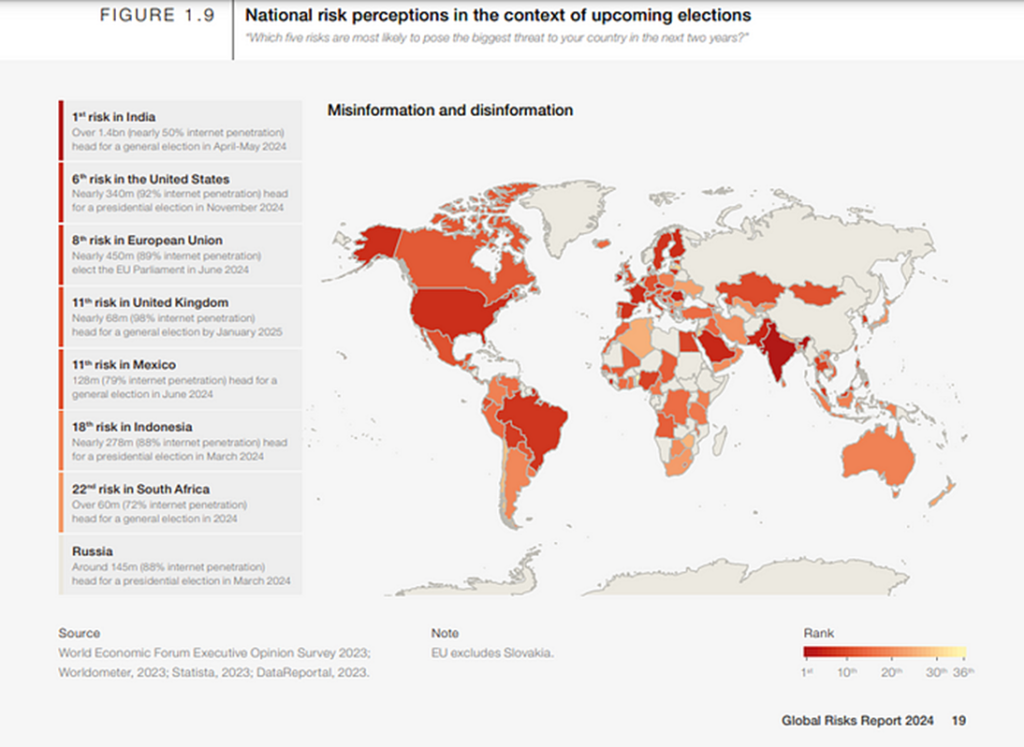
According to the Global Risks Report, the turmoil disinformation may create could fuel protests, lead to violence and, beyond that, threaten democratic processes. Questioning of the legitimacy of elections, and this escalating into civil strife, civil war, terrorism and, in more extreme cases, state collapse, are also among the possibilities the report highlights. (Global Risks Report 2024, p. 19)
The report also states that all the risks it lists interact with one another to varying degrees. The impact of the misinformation and disinformation risk on other global threats is considerable. The problem of misinformation and disinformation is linked to many other global risk factors, from the erosion of human rights and societal polarisation to cyber security problems and bad actors in the field of AI.
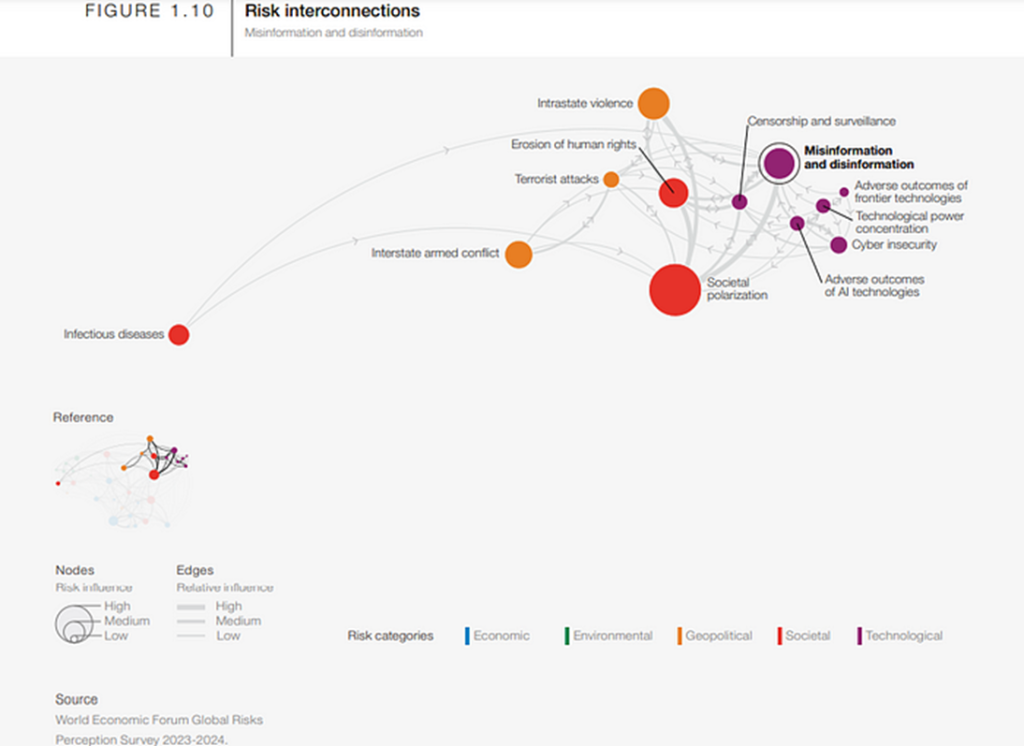
Is Disinformation the World’s Biggest Problem?
While the report offers a two-year projection that puts disinformation at the centre, partly because of the elections to be held in 2024, and reaches out from it to other connected risk factors, one basic question comes to mind:
Is misinformation and disinformation really the world’s biggest problem?
The report itself in fact answers this question. We can say that the long-running problems that have grown and become more tangible in recent years appear in the ten-year risk outlook.
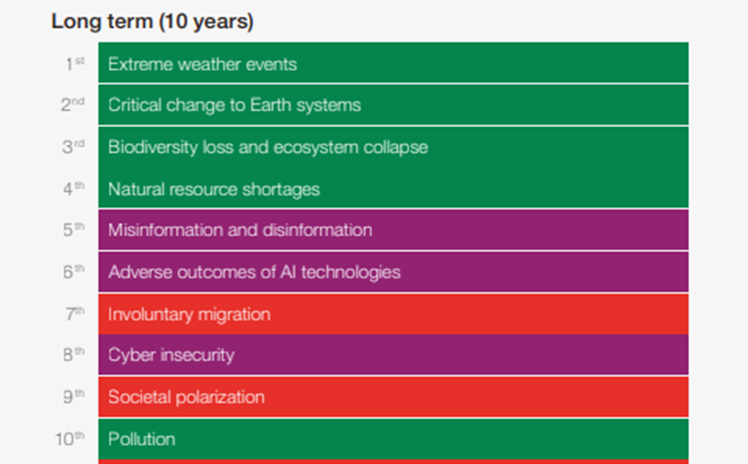
Climate and directly related risk factors such as “extreme weather events”, “critical change to Earth systems”, “biodiversity loss and ecosystem collapse” and “natural resource shortages” are listed as the major long-term risks facing our world.
After the four risk factors at the top come “misinformation and disinformation” and “adverse outcomes of AI technologies”, the subject of this article, in fifth and sixth place.
Another risk factor expected to arise from extreme weather events and climate change is climate migration. Those who would like to read more on this can take a look at Semih Durmaz’s article “Migration in the New World Order”.
Finally, cyber security, societal polarisation and pollution are considered other important risk factors that will force the world to think and find solutions over the next decade.
In conclusion, humanity looks set to spend 2024 trying to minimise the effects of AI-driven disinformation and related problems, given the role they are likely to play in the elections approaching around the world.
I hope this will not delay more determined and concrete steps to tackle climate change and the risks directly associated with it, which will cause bigger problems in the long run.
Sources
- World Economic Forum – Global Risks Report 2024 weforum.org
Monthly · free
Compass of the Month
Once a month: five points from Europe’s security and migration agenda and the month’s PUGAT articles, in your inbox.
Newsletter sign-up opens soon.
Read next


What is PUGAT? A non-profit community publishing independent analysis from Europe on security, migration and society in Turkish, German and English.
Go to the homepage
