


Explaining the rise of the far right in Germany through politics alone falls short. The issue lies in the fear of people who feel forgotten. The author argues that the answer lies not in fear but in confidence.
Sometimes the best way to understand a society is to look in the mirror. But to really look… Not just at our faces, but at the traces behind them, the cracks, the lines that time has left.
Germany today stands somewhat in front of such a mirror. At first glance everything looks orderly: strong institutions, a functioning bureaucracy, a disciplined economy. On paper the system is almost flawless. But look a little more closely into the mirror and you notice something else. It is as if there were a fine crack in the glass. Not very big, but it is there all the same. You would have to look away not to see it.
The question so often asked in recent years arises precisely from here: why is the far right rising so fast in Germany?
There are easy answers to this question. But easy answers are often not the right ones, because the issue lies beyond politics, deeper down, hidden in people’s feelings.
Today many people in Germany carry a sense of uncertainty. People feel that control over their lives is slowly slipping out of their hands. The feeling that the future is no longer as predictable as it once was is growing. And this growth sets fear in motion.
Yet Germany is not a country to be defined by fear. On the contrary, we are talking about a society that managed to get back on its feet after the heaviest destruction in its history. A country that built a democracy out of cities reduced to ruins. There is therefore no reason to believe that today’s pessimism is permanent.
But first we need to see the crack in the mirror and understand why it appeared.
Simply Saying “I’m Against It” Is Not Enough
Being against something is easy. Sometimes a single sentence makes us feel good. For example: “No to the far right.”
That sentence is of course important. But on its own it solves nothing and leaves gaps behind it. And radical ideas usually grow in such gaps. They take root where people feel alone and believe their voices are not heard.
When people feel they have lost control of their lives, even the harshest slogan can sound reassuring, because simple answers are always comforting.
If a father is wondering how he will pay the bills at the end of the month, explaining the theoretical virtues of democracy to him is of little use. If a young person feels their future is uncertain, telling them to be patient is not enough.
People first want to feel safe.
The People Who Say “They Have Forgotten Us”
In recent years a similar sentence has been heard in different parts of Germany: “They have forgotten us.”
You can hear this sentence not only in eastern Germany but also in small industrial towns, in rural areas, even on the outskirts of big cities.
People do not always complain about an economic crisis. Sometimes it is a feeling that triggers dissatisfaction. It is as if the system is moving forward while they are left behind.
Take the state. The state can sometimes look very powerful and yet feel very distant.
If citizens encounter the state only through tax letters or complicated forms, the bond between them weakens. But when a new school opens in a neighbourhood, when a factory is saved from closure or when a family manages to find affordable housing, the state becomes visible again.
Equality is often born less from grand political slogans than from small, everyday, ordinary moments.
For democracy, a person not feeling forgotten often becomes more valuable than theories that would fill whole volumes.
The Door to the Future
One of the strongest antidotes to radicalisation is education. But education is not just knowledge.
It matters that a young person can internalise this thought: “If I work, there is a place for me in this society.”
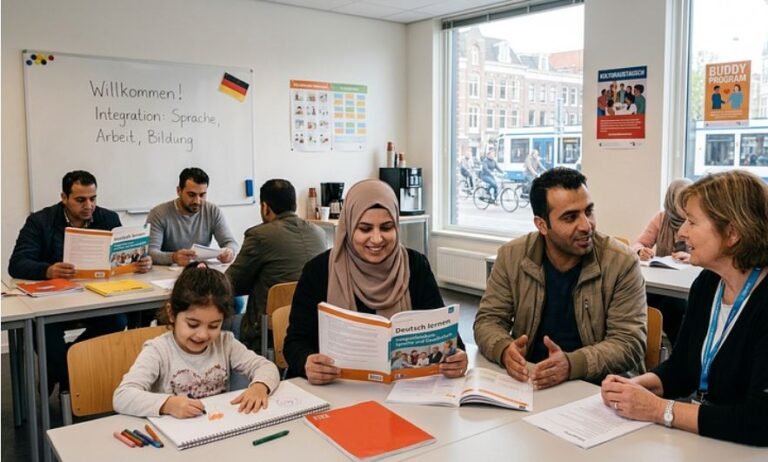
Today in Germany, young people with a migrant background and young Germans alike may be asking the same question: “Where is our future?”
In a system where the recognition of diplomas gets lost in years of bureaucracy and vocational training becomes harder and harder to reach, the answer to that question can become blurred. Yet in a society where work is valued, people need radical solutions less.
People who can see their future do not easily believe the promises of hatred.
The Crack in the Mirror
The dark years of the 1930s are often recalled in Germany. This reminder is important, because some pages of history can be written again if they are forgotten. But history is not only the story of disasters. It is also the story of rising again.
Germany has done this once. After severe destruction, it built a strong democracy. The problems it faces today are different, but not insoluble.
The real issue is one of direction. Societies sometimes walk towards fear and sometimes towards solidarity. Today the simplest question we should be asking is: “How can we live together?”
If justice is felt not only in courtrooms but also in everyday life, if people continue to see one another as neighbours rather than rivals, then the crack in the mirror will slowly begin to close.
The possibility is there. So is the strength. Will we use this strength to magnify our fears, or to build a shared future?
Monthly · free
Compass of the Month
Once a month: five points from Europe’s security and migration agenda and the month’s PUGAT articles, in your inbox.
Newsletter sign-up opens soon.
Read next

What is PUGAT? A non-profit community publishing independent analysis from Europe on security, migration and society in Turkish, German and English.
Go to the homepage
