

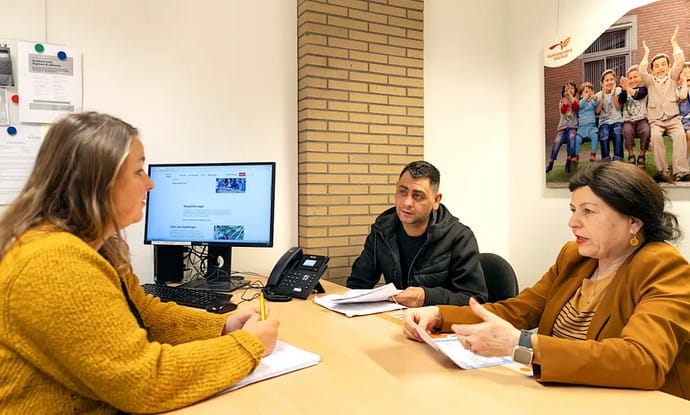
The fate of an asylum application is largely decided in the interview. What is asked from the preliminary interview through to the main interview, how credibility is assessed and the most common mistakes.
In this part we look at the most critical stage of the asylum process, the initial examination and the personal interview (asylum interview): how the applicant’s credibility is assessed, the mistakes most commonly made in interviews and the key factors that directly affect the chances of recognition.
Initial Examination and Main Interview
Once an application for international protection has been lodged, the first stage is the initial examination or preliminary interview. In this interview the authorities first establish the applicant’s identity and travel route and carry out a general security check.
In Germany, for example, the first interview asks about identity, nationality, where the applicant has come from and by which route; the reasons for seeking asylum are left for the main interview. In the Netherlands, an IND officer similarly tries to establish the applicant’s identity, family, the details of the journey and whether there is a need for protection.
At this stage biometric data such as fingerprints and photographs are recorded (for EURODAC), and a check is made as to whether the person has previously been registered in another EU country.
The initial examination also determines which procedure the application will follow, and checks whether another country is responsible under the Dublin criteria (since 12 June 2026, the Asylum and Migration Management Regulation, AMMR, part of the EU Pact on Migration and Asylum). Applications that contain no protection element at all and are “manifestly unfounded” may be channelled into an accelerated procedure. Applications from safe countries of origin such as Bosnia and Herzegovina, for example, are generally examined in this way, so the process may be concluded at an early stage. Coming from a safe country of origin does not, however, mean that an application is rejected without the applicant’s personal circumstances being heard.
Applicants from countries such as Turkey who put forward a political or individual risk, on the other hand, have their grounds for protection examined in detail on the merits at the main interview. Which procedure applies, however, depends not only on the country they come from but also on which state is responsible and on their personal circumstances. Since June 2026, as Turkey has fallen under the EU-level list of safe countries of origin, applications from Turkish nationals are as a rule examined in the accelerated procedure; this does not remove the individual assessment or the personal interview. Before reaching this initial examination, it is also very important for applicants to verify their personal details, put any documents such as identity cards and diplomas in order, and obtain accurate information about the Dublin criteria.
Applicants should remember that the interview is not a defence but an assessment of a request for protection, and should keep in mind that missing information or documents may cause problems at a later stage. Where necessary, the provision of an interpreter or psychological support is also raised at an early stage.
Main Interview (Personal Hearing)
Once the initial examination is complete, the process moves on to the main interview. This is the most critical interview stage, the one that largely decides the fate of the asylum claim.
The officials (for example, BAMF officers in Germany, IND officers in the Netherlands, CGRS protection officers in Belgium) ask the applicant very detailed questions here. The aim is to establish whether the asylum account is consistent and true. During the interview the applicant is asked to give a chronological account of “why they left their country, what threats they faced there and what risks they would face”. In the Dutch interview, for example, the officer asks the applicant to talk “about yourself and your application”, learning in detail who you are, where you come from, what you went through that led you to seek asylum and why you cannot return to your country. Documents, witness statements or social-media evidence support the account. The focus of the interview is whether the applicant’s account is realistic and consistent.
Applicants need to prepare very thoroughly for this stage. They should recount events in the order in which they happened, showing cause and effect, and avoid contradictory or superficial statements. If necessary, they should rehearse likely questions in advance and, in particular, identify points left out of earlier statements and plan how to explain them. In the Netherlands, for example, interviews may touch on questions such as “When did you realise your sexual orientation?” and “How did your family react when you told them?”; LGBT+ applicants should be prepared for questions of this kind. In Germany, people who have experienced sexual or gender-based violence have the right to ask for a specially trained interviewer (Sonderbeauftragte für geschlechtsspezifische Verfolgung). An interpreter is present throughout the interview and, at the request of the applicant or their adviser, can be of a particular gender. In Belgium, for example, the CGRS meets a request concerning the interpreter if it has been made in advance. Knowing that this interview is not a court hearing, and seeing it as a neutral exchange of information, will also help the applicant feel more at ease.
The main interview carries great weight: this is the stage at which the outcome of the application is all but settled. If the account is inconsistent, it is hard to correct later; events that were forgotten or only partly described and are added afterwards can damage credibility. Applicants should therefore focus on the following points:
- Building a chronological and detailed account;
- Clearly identifying the elements of persecution and threat;
- Supporting the account with documents;
- Avoiding possible denials and contradictory statements.
Where necessary, it is also possible to ask for a break during the interview or for a moment to catch one’s breath. A question that has not been understood can be asked again. In short, applicants should set aside time for the main interview and prepare to give a complete and convincing account at this stage. A well-prepared account significantly increases the chances of recognition.
Sample Pre-Interview Preparation Checklist
In preparing for the interview, applicants should bear the following steps in mind:
- Document identity and civil-status details and check copies of passports or identity cards.
- Structure chronologically why they left their country and clarify the core story they will tell.
- Identify the elements of persecution, threat or risk (political identity, membership of an ethnic or religious minority, LGBT+ status, etc.) and prepare the documents.
- Make sure events are described with dates, places, the people involved and their consequences, and take notes on them.
- Strengthen the case for protection by highlighting the risks they would face on return.
- Identify difficult topics that may come up in the interview (trauma, harassment, gender or political identity, etc.) and arrange psychosocial support if necessary.
- Rehearse likely questions and answers; practise working through complicated timelines.
- Check consistency with information given in earlier statements and before the interview; correct any contradictions.
- Present documents and evidence in a suitable and logical order; make sure the account does not contradict the documents.
- Inform the applicant that the interview is not a trial and that its purpose is protection rather than legal proceedings.
- Remind the applicant that breaks can be taken during the interview where necessary, and not to forget to ask the interpreter to repeat anything they have not understood.
In our next article we will continue with “The Decision Stage and Beyond”.
Sources
- BAMF – The asylum procedure step by step (German) bamf.de
- IND – Asylum procedure (Dutch) ind.nl
- CGRS/CGVS (Belgium) cgrs.be
- UNHCR unhcr.org
Monthly · free
Compass of the Month
Once a month: five points from Europe’s security and migration agenda and the month’s PUGAT articles, in your inbox.
Newsletter sign-up opens soon.
Read next


What is PUGAT? A non-profit community publishing independent analysis from Europe on security, migration and society in Turkish, German and English.
Go to the homepage
