


For many, studying in Germany or the Netherlands is also the first step towards a permanent life there. Visa requirements, the blocked account and the right to look for work after graduation determine how this path works.
Europe’s Strategy for Skilled Young People
Ageing populations and low birth rates mean that European countries need young workers more than ever. Their higher-education institutions therefore offer attractive programmes to draw in foreign students, and countries such as Germany and the Netherlands have introduced rules that help international students join the labour market after graduation.
In Germany, for example, foreign students are granted a study visa if they hold a suitable university admission letter and can show sufficient funds to cover their living costs for the first year. After graduation they also receive an additional residence permit for up to 18 months to look for skilled employment.
In the Netherlands, universities attract students by offering internationally accredited programmes, and students are granted a residence permit when the institution sponsors their full-time studies. In short, European countries have come to promote migration through education in order to offset weak domestic population trends and bring global talent into their knowledge economies.
Germany: The Student Visa and Opportunities after Graduation
University education in Germany is free or carries very low fees, which makes it highly attractive to foreign students. To apply for a study visa, candidates must first be admitted by a German university and show that they have enough money to cover their first year’s living costs (a blocked account, a scholarship, etc.). While studying, students may work part-time for up to 20 hours a week. On graduation, a job-search permit of up to 18 months comes into effect; during this period foreign graduates may take any qualified job and extend their residence on that basis. If they receive a job offer after graduating, they can apply for an EU Blue Card or a standard work-based residence permit.
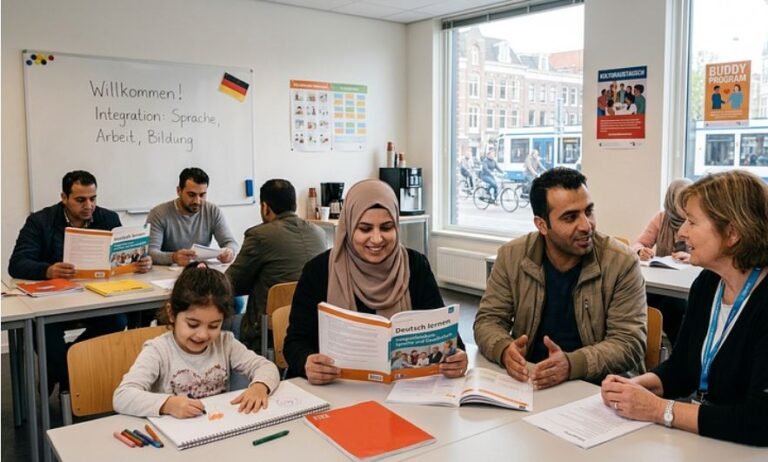
Going to Germany for language training or preparatory study is another option. Native Turkish speakers, for example, can improve their German through language courses or preparatory programmes such as the Studienkolleg before starting higher education. During the post-study job search it is important to take out health insurance and prepare for German workplace culture. Under Germany’s General Equal Treatment Act (AGG), foreigners also enjoy equal rights in education and at work; in the event of any violation, support is available from trade unions or official bodies.
The Netherlands: The Sponsorship System and the Post-Graduation “Zoekjaar”
With its wide range of English-taught programmes, the Netherlands is an attractive destination for international students. Dutch universities and universities of applied sciences (HBO) that invite students hold the status of “recognised sponsor”. These institutions can apply for a residence permit directly on behalf of the students they admit. The application requires proof that the student has been admitted to a full-time programme at a recognised institution, that the programme is accredited by the Dutch or an international accreditation body, and that the student has funds equal to the “study norm” amount.
In the Netherlands, too, students may work full-time during the summer months outside the academic year and up to 16 hours a week during term. EU/EEA nationals can work full-time without a work permit, whereas students from non-EU countries such as Turkey need a work permit (TWV) obtained through their employer. Another important opportunity after graduation is the “zoekjaar” (search year) visa. Graduates of Dutch universities or of universities ranked in the global top 200 can obtain a one-year job-search visa, provided they apply within three years of graduating. During this period they are free to apply for jobs, work full-time or start their own business.
Preparation and Adjustment: Realistic Expectations
International education migration does not end with a letter of admission; it requires solid preparation and follow-up. Before applying for a visa, candidates should gather all their academic documents, such as the letter of admission, diploma and notarised transcript, and prepare the financial resources to show roughly €12,000 in a blocked account for Germany (about €992 a month according to 2026 figures) and, for the Netherlands, the annual amount specified as the “study norm”. Documents such as a valid health insurance policy, proof of address and a criminal record certificate may also be requested during the visa application.
Once settled, official formalities come first: in Germany, registering one’s address (Anmeldung), obtaining a tax ID and updating health insurance; in the Netherlands, obtaining a BSN from the municipality and taking out Dutch health insurance. In both countries, newcomers should master the local language as far as possible in order to adapt quickly to their new social and working lives. Where diploma recognition is needed, the procedure should be started early; otherwise obstacles to working in one’s profession may arise at the end of one’s studies. In working life, the General Equal Treatment Act (AGG) in Germany and the Equal Treatment Act in the Netherlands protect foreigners against discrimination. If problems arise, support is available from trade unions, employment law advisers or official complaint mechanisms.
Sources
- Make it in Germany – Studying in Germany make-it-in-germany.com
- Federal Foreign Office – Information on the blocked account auswaertiges-amt.de
- IND – Orientation year (zoekjaar) ind.nl
Monthly · free
Compass of the Month
Once a month: five points from Europe’s security and migration agenda and the month’s PUGAT articles, in your inbox.
Newsletter sign-up opens soon.
Read next

What is PUGAT? A non-profit community publishing independent analysis from Europe on security, migration and society in Turkish, German and English.
Go to the homepage
