

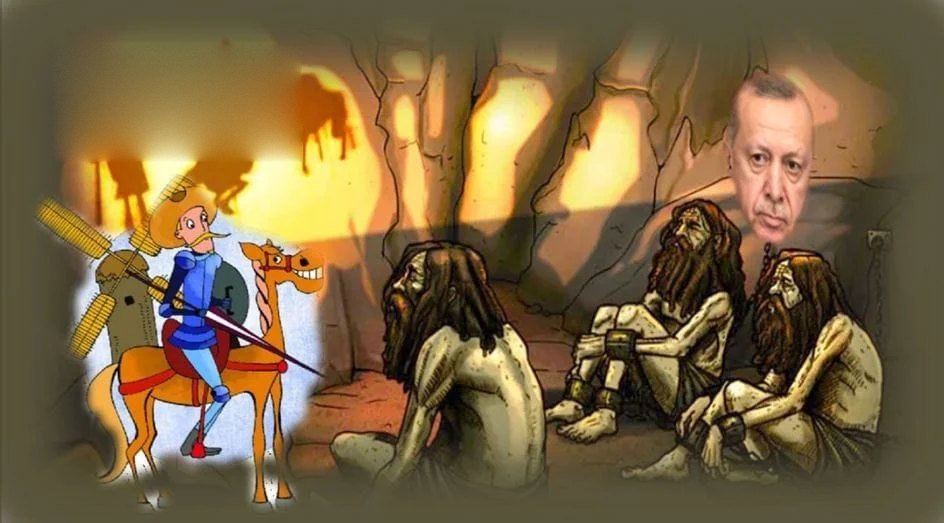
From Plato's world of Forms to Don Quixote's windmills: The author uses philosophical references to interpret the profile of a politician who wages war according to the ideal world in his own mind.
Plato’s world of Forms consists of the physical and the metaphysical world. According to Plato, the beings we perceive in the physical world and the real beings we picture in our minds are not one hundred per cent the same. The living things of this world are mere perceptions, and we cannot pass definitive judgements about them; we can only generalise.
Plato speaks of Forms not only of objects but of goodness, beauty, justice, honesty and even thought. In short, he says this world is a reflection of the world of Forms. So people do not live in the world of Forms but in a world of shadows, and he explains this with the famous “allegory of the cave”. People sit in a cave, their legs and necks chained, their backs turned to the cave’s entrance. In this position they watch the reflections on the cave wall of the light coming in through the entrance. The reflections on the wall are the shadows of the real people, animals and objects outside the cave. According to Plato, the phenomena people perceive with their senses in this world and try to define are limited to the meanings they give in their minds to the shadows on the cave wall.
Plato also argues that in order to perceive the existence of a thing, a person must have known it before. That is, if I had not known beforehand that the tree in front of me is a tree and that it is beautiful, could I describe it as other people perceive it? If I had not known the concepts of equality, difference, similarity, honesty and goodness before, could I classify them in this way? He tries to answer such questions. He therefore argues that people bring this knowledge with them from birth and takes up the concept of the “human soul”. He explains the state of the human soul in the physical world as lying between the world of Forms, which has no beginning and no end, and the world of objects we perceive. In short, he also says that man knows the real beings in the metaphysical world and that the beings of this world are low-quality equivalents of their originals in the metaphysical world.
Dear readers, I would also like to tell you about Miguel de Cervantes’s Don Quixote, which I think is connected with this subject.
Don Quixote is a Spanish novel written by Miguel de Cervantes in the early 1600s. The novel tells of the adventurous journey of Don Quixote and his servant Sancho.
Influenced by the books he has read, Don Quixote wants to revive the chivalric spirit of olden times. He takes the lance and sword from his cellar and puts on his armour. He mounts his weak, skinny horse, which he sees as a thoroughbred steed. His aim is to help those in desperate straits, punish the wicked and win worldwide fame.
In one part of the novel, Don Quixote fights the windmills because he sees them as evil giants harming people. Although his servant Sancho warns him, he attacks the windmills. Although the windmills hurt Don Quixote, he keeps attacking them again and again with great courage and without giving up.
Living in a dream world, Don Quixote confuses the reality of his imagination with events in the world. In one part of the novel he thinks galley slaves are innocent people and tries to free them. In another he takes two flocks of sheep for two armies fighting each other and attacks one side to help the outnumbered. In the end he gets a good beating from the shepherds…
When we link the example in Plato’s allegory of the cave with Don Quixote’s psychological state, we can say that Don Quixote’s knowledge of the Forms is affected by incomplete and wrong perceptions and judgements. He cannot assess events as normal people do and steers his physical world with the extraordinary interpretations he pictures in his mind. Although, as Plato says, people have innate Forms, these can be affected by factors such as a person’s education, abilities, mental health, surrounding conditions and physical deficiencies (blindness, deafness and so on).
Now imagine a politician who creates enemies built on imaginary foreign powers. He sees those who oppose him as centres of evil. He otherises those who do not support him and sets them apart in the eyes of society. He can whitewash his crimes by finding a religious cover for them. He sees the nation’s property as a sea to draw from and considers it normal to hand it out to his cronies. He declares himself a world leader. While the country’s economy has sunk, he says a tremendous development momentum has been achieved. He claims the world envies us. He speaks one way in the west of the country and another in the east; he can say tomorrow the exact opposite of what he says today. In short, he can call black white and white black, and considers it normal to manipulate people to make them believe this is true.
When we think of the famous allegory of the cave in Plato’s world of Forms and Don Quixote’s psychological state, how should this politician’s behaviour be assessed?
Stay well.
Monthly · free
Compass of the Month
PUGAT’s monthly newsletter.
Read next


What is PUGAT? A non-profit community publishing independent analysis from Europe on security, migration and society in Turkish, German and English.
Go to the homepage
