

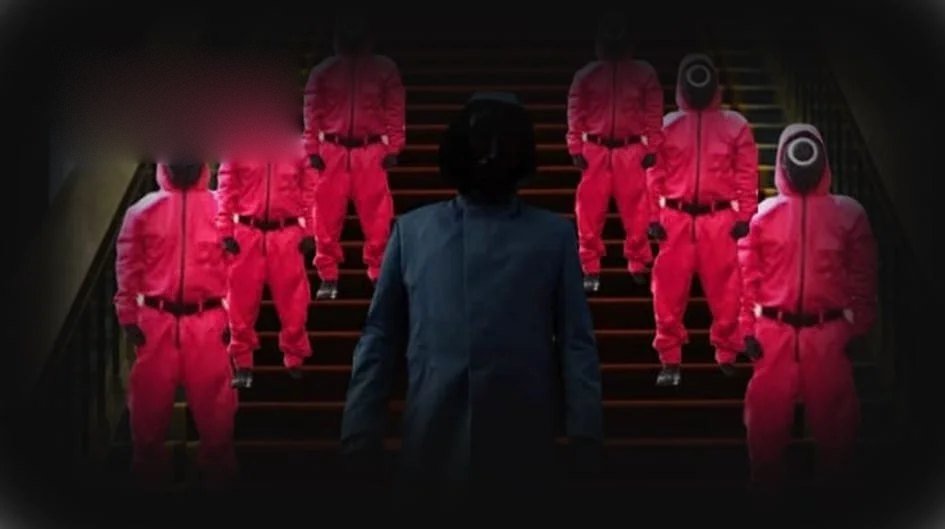
Squid Game reached more than 111 million people in its first month. The author adapts the series’ dystopian world to our own social reality through “the managers and game masters”.
Who would have thought that a television series would be watched by more than 111 million people in its first month alone? And with a script that no one even looked at ten years ago…
So what is the secret of this series’ success and the reason for this interest? Why and how did the dystopian world constructed in the series lock millions of viewers in front of the screen in such a short time? How about looking for answers to these questions in our own dystopia, specifically in “the managers and game masters”?

Squid Game, broadcast on Netflix, is a work that combines the innocence of children’s games with slaughter, spicing up contrasts with exaggerated scenes of violence and death and adapting them to social realities. Its masked characters, designed with inspiration from the hierarchy of duties among ants, its set and its music are other important details that feed the series’ story…
Although often criticised, Squid Game, a South Korean series in the drama, action and especially dystopia genres, already seems to have written its name into the literature. While the series portrays the lives of capital owners and players, it also criticises the global system and social inequality through children’s games in which “the losers pay with their lives”.
In this respect the script quickly builds a bond with the viewer. As a result of the bonds they form with the characters and events in the series, viewers find themselves right in the middle of the dystopian world created in the script. I suspect the secret of the interest and success also lies in everyone finding something of themselves and the world they live in, and in the criticism of the order they constantly question in the back of their minds…
Masked Billionaires and the Manager
Squid Game’s director Hwang Dong-hyuk sheds light on the other side of the coin using impressive metaphors that raise curiosity to the highest level. To do so, he uses the character of a policeman who enters this deadly system while searching for his brother.

Here we encounter the VIPs, that is, the owners of capital, with their animal masks. In the order they have built, all values, including human life, are disregarded for the sake of their wealth, interests and even pleasures. Unfortunately, people are nothing more than numbers to them; but in real life it is not so easy to identify the identities the VIPs represent. Natural and legal persons, companies, secret or transparent organisations, even states can take on this role. But the more visible part of the order is that the VIPs run the whole process through managers.
Within the framework drawn so far, when we approach the matter from a social perspective, the manager position fits country leaders best. Trump, Putin and Erdoğan are the first who come to mind.
Justice and Their Order
The “manager” in the series initially convinces us all that the game is played within a fair order. He even has a motto, in his own words: “We are giving each person who has suffered injustice and discrimination in the outside world a last chance to win a fair race.” A kind of election promise… It must be customary to always present justice and stability as the goal to be reached at the beginning!

The last clause of the three-point rulebook gives the players the right to end the game by majority vote. The existence of such a right in an order under authority is of course surprising, but the system needs this emphasis so that everyone feels good.
Meanwhile, the bundles of prize money raining into the giant sphere hanging from the ceiling of the building before the vote are also a metaphor used to keep people’s material weaknesses alive before their decision.
Don’t be surprised if in season two they throw a few packets of tea into the sphere!
The director wakes us from this “right to vote” illusion when, after the game is cancelled, 187 of the 201 people return to the game of their own free will. The reason they return is that the situation outside is no better than inside… In other words, a kind of “lack of alternatives and helplessness.” To tell the truth, the situation in real life is not much different.
This in fact proves how skilfully the game masters do their job. Our surroundings are designed in such a way that the player/citizen who thinks he has got rid of something he did not want through his own vote returns to the game because of the need for security that arises after terrorist incidents that suddenly appear. Again, lack of alternatives and helplessness…
Meanwhile, the fact that mass deaths and massacres are not just film scripts is the bitter side of it.
The fiction of a so-called opposition is also one of the best-known and most easily noticed examples of design in our country. Otherwise, how else, except by the concept of “being designed”, can we explain the “nationalists” who in public squares called the ruling party “thieves, cowards, without honour” and said they would not have the breath to climb to Çankaya, later becoming the guardians of Beştepe?
Returning to the series, those who watched it will remember that the management, which watches and controls everything, knowingly remains a spectator to what happens in a deadly fight and contributes to all the players lynching each other that night by darkening the lights.
In this example too we witness the management bending and twisting justice as it wishes and causing controlled chaos. Likewise, in the game in which a bridge with a glass floor must be crossed, the manager, after noticing the player who distinguishes a pane that can bear his weight with the help of light reflected on it, darkens the lights and destroys the bridge, which is ruthless. In other words, the fiction is a series of traps already designed for most of the players to die…
While watching these two scenes, somehow the military students and privates who were trapped on the bridge on 15 July and savagely killed by people who had lost their humanity came to life in my mind.
For women, unfortunately, the situation is not very encouraging either. Games based on muscle strength in which no one gives them a chance of surviving, a life in which their safety is constantly threatened by bullies, and a management that does not care about gender equality… The fact that the only clothes prepared for the finalists at the feast before the last game are tuxedos also shows the intention and foresight the management lets slip.
Manager Traits / Scenes from the Series
Although the managers appear powerful and sovereign to the outside, they are in fact simple officials who keep the desired mindset alive with their arrogance, splendour and bullying within the area drawn for them by the VIPs, and who always have alternatives. That they can sacrifice even their closest ones, their families or fellow travellers without batting an eyelid for the duty they have sought of their own free will is the kind of thing that makes one say “this is too much”. Those who watched the series will remember the scene in which the manager sacrifices his own brother.
Nor should we overlook that while the players make do with a piece of bread and a soda for a meal, the manager carries on living in luxury. In his time off duty, he enjoys his gold-leafed room, sipping his drink to jazz music. Of course, living this luxury within the area drawn for him has a condition: obeying every instruction, like the ringing telephone in the series, and doing everything he can to please the VIPs.
In short, for the managers, the voluntary officials of the dark order, nothing matters except the tasks given to them and the benefits they gain in return.
Examples similar to the series can be found in literature: Suzanne Collins’s The Hunger Games, Jack London’s The Iron Heel, Franz Kafka’s The Trial and George Orwell’s 1984 are some of them…
In all of them attention is drawn to political, economic and religious problems. Dystopia practically turning into society itself is treated as a global issue.
In this article we have attempted an exercise in awareness through the character of the manager in our own dystopia. Awareness, as we discussed in our earlier articles, is both the antivirus of our minds and an important stage to be reached individually before a solution. Yes, individual awareness and development alone are not enough for a solution, because we are all in the same boat and are affected collectively by adversity.
The answer to the question “So what is the solution?” is unfortunately not simple enough to be listed in a few points. Here, after individual competence, we face the issue of building the mass, that is, the ideal model of society. Social peace, solidarity and collective consciousness are therefore indispensable for a solution. This too is a difficult and layered process. At this point I recommend you also take a look at these (1, 2, 3) series of articles.
Taking into account the positive attitudes of character number 456 in the series, we can say that there is always hope, and that hope is us. As we are and as we deserve, so shall we be governed.
Monthly · free
Compass of the Month
PUGAT’s monthly newsletter.
Read next


What is PUGAT? A non-profit community publishing independent analysis from Europe on security, migration and society in Turkish, German and English.
Go to the homepage
