

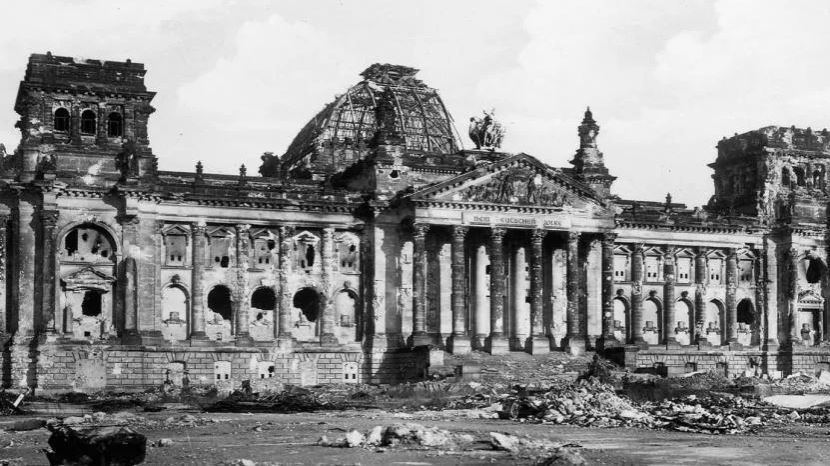
The fire that broke out in the Reichstag building on 27 February 1933 opened Hitler’s path to absolute power. The third part of the self-coup series tells the most famous example in history.
In the first article of this series I explained the self-coup in general, and in the second I recounted the intrigues of Cleomenes III, its first known example in history.
This time I want to take you to the most famous known example of a self-coup: Hitler’s Germany and the “Reichstag Fire”!
The Reichstag Fire is an event in which a despot who had seized power but, finding it insufficient, sought absolute power, opened the door to the Nazi inferno with a fire taken from a building and kindled a far greater fire that would burn millions of people.
Where there is smoke there is fire, and where there is fire, conspiracy theories are certain to follow. At least that was the case when, on 27 February 1933, much of the Reichstag, the German parliament building in Berlin, went up in flames as a result of an arson attack (2).
Some claim the Nazis were behind it, while others think otherwise. Had Hitler plotted against his own people with this fire, or were all these just conspiracy theories? The answer to these questions could not be clarified either during the Nuremberg trials or in all the years since, as the German state and people confronted this shameful history, for which I think they have at least made a sincere effort as a nation.
In my view, what matters here is not who set the Reichstag on fire, but the timing of the event and who profited from it.
Now to the cold and dark air breathed in Germany just before the fire!
Defeated in the First World War, the country had been badly damaged and was overflowing with economic hardship and political uncertainty. Hitler’s power was born after just such a catastrophe, in which the country’s resources were exploited by the victorious states and the people were condemned to hunger and misery.
In this dark period into which Germany had fallen, Adolf Hitler, leader of the National Socialist German Workers’ Party, which won 37 per cent of the vote in the elections of 31 July 1932 and 33 per cent on 6 November 1932, was appointed chancellor of a coalition government by President Hindenburg on 30 January 1933.
Hitler had come to power, but he did not yet have the power to implement the policies that would transform Germany according to his vision. For Hitler’s ambitions and ideology were aimed not only at political victories but also at suppressing his opponents and eliminating every threat against him. For this he needed extraordinary powers, and he had already asked the President to have certain powers taken from parliament and given to him.
Every fire is a spark for bigger fires!
It was in this atmosphere, around nine in the evening of 27 February 1933, that an event occurred that would shape Germany’s destiny at its roots: the parliament building, the “Reichstag”, had been set on fire!
Hitler and the Nazi Party wasted no time in coming to the scene and turning it into a rally ground, turning the event into a great political opportunity. Without even waiting for a trial, it was claimed that the arson had been carried out by communists. On the night of the incident, Hitler and his team announced the culprit that same evening, declaring that international communism had attacked German unity and order with a cocktail organisation, targeting everything connected with communism, all communists and social democrats, and saying they would show no mercy to anyone.
A mentally unstable Dutch worker named Marinus van der Lubbe was arrested as responsible for the arson; communists were caught and put on trial.
Hitler thus said the fire was “a sign from God”, a signal heralding the beginning of an imminent communist uprising, and the newspapers called the event “a Bolshevik act of terror in Germany”.
The scorching fire of Nazism engulfs an entire country
Just as former US President James Madison particularly pointed out that tyranny arises in “some extraordinary cases”, the Reichstag fire was not only an act of arson but also a turning point in which Hitler consolidated his power.
The day after the Reichstag fire, the legal order was suspended by the “Decree of the Reich President for the Protection of People and State (Verordnung des Reichspräsidenten zum Schutz von Volk und Staat)”.
With this decree Hitler was given broad powers and the silencing of opponents was made easier. The personal freedoms listed in the Weimar Constitution were suspended. A state of emergency was declared, personal freedoms were restricted, freedom of thought was destroyed, press censorship was imposed, opposition parties were closed and the power of the Nazi Party began to grow steadily.
This fire was used as a sharp tool for Hitler to strengthen his rule and turn Germany into an authoritarian regime. Hitler now had the opportunity to shape Germany in his own image, and the scorching fire of Nazism had engulfed an entire country.
The power that transformed Germany, suppressed opponents, passed anti-Jewish laws, established a dictatorial regime and left a black stain on the history of a whole country had been ignited by this very fire!
A 100-Year Similarity
Despite the nearly 90 years that have passed, humankind, which has not learned its lesson, still goes on collecting new albums of fires at which future generations will shudder.
The Reichstag Fire, not only in the course of events and the visible damage to the parliament buildings but also in the blows it dealt to fundamental freedoms and the possibility of critical thought and in opening the roads to tyranny, closely resembles the 15 July incident.
In both events parliament buildings were targeted. Just as Hitler and his team, who were prepared on the night of the event, immediately turned the site into a rally ground, so too on 15 July the Erdoğan government, the AKP organisations and the HSYK under its command were prepared, and the attempt was immediately turned into a party propaganda tool.
On 23 March 1933, with the Enabling Act, all powers of the German parliament were transferred to the cabinet and Chancellor Hitler for four years, and parliament’s work was suspended for that period. With the decree he had the President sign the day after the fire, Hitler suspended the rights and freedoms in the constitution.
In Türkiye too, five days after the coup, a three-month state of emergency was declared and all legislative and executive power was concentrated in Erdoğan. The country was governed by emergency decrees. The powers were extended a full seven times, until Erdoğan held all power in his hands. Opponents were constantly targeted, and their rights and freedoms were suspended.
Just as many of parliament’s powers were given to the Führer (Hitler) after that night, so too after 15 July Türkiye left the parliamentary system for a partisan presidential system, and through a referendum many constitutional powers were concentrated in a single person. Indeed, the then Prime Minister Binali Yıldırım confirmed this truth by saying, “The door to the presidency was opened on the night of 15 July” (4).
And don’t forget that back then too these powers were granted by referendum! When President Paul von Hindenburg died on 2 August 1934, Hitler also assumed the office of president. This “fait accompli” was put to a referendum, and the German people, with 89.93 per cent voting “yes”, approved Hitler becoming president while also continuing as chancellor.
Just as Hitler, after obtaining under Article 46 the power to appoint and dismiss all civil servants, began a campaign of annihilation against the Jews, Erdoğan too launched a witch hunt against all his opponents and the secular sections of society.
Conclusion
The truths behind this event, a catalyst for Hitler’s consolidation of power and the rise of Nazism, have still not been fully brought to light.
This dark event, which led to one of the greatest tragedies in human history, must be well understood so that today’s events and phenomena can be well understood. Otherwise, despite the nearly one hundred long years that have passed, only differences of translation remain between the rhetoric and slogans of those in power:
What one calls “a signal from God”, the other calls “a gift from God”; the slogan that in that era was “Ein Volk, ein Reich, ein Führer!” (“One people, one empire, one leader!”) goes on being chanted as “One nation, one flag, one homeland, one state”!
Sources
- Barış İçin Akademisyenler barisicinakademisyenler.net
- Smithsonian Magazine – The True Story of the Reichstag Fire smithsonianmag.com
- Evrensel – Reichstag yangını sürüyor evrensel.net
- OdaTV – Başkanlığın kapısı 15 Temmuz gecesi açıldı odatv.com
- Mercan Doğan – Reichstag hâlâ yanıyor mirror.anarhija.net
- Artı Gerçek – Can Dündar, Reichstag yangınını 15 Temmuz’a benzetti artigercek.com
Monthly · free
Compass of the Month
PUGAT’s monthly newsletter.
Read next

What is PUGAT? A non-profit community publishing independent analysis from Europe on security, migration and society in Turkish, German and English.
Go to the homepage
