

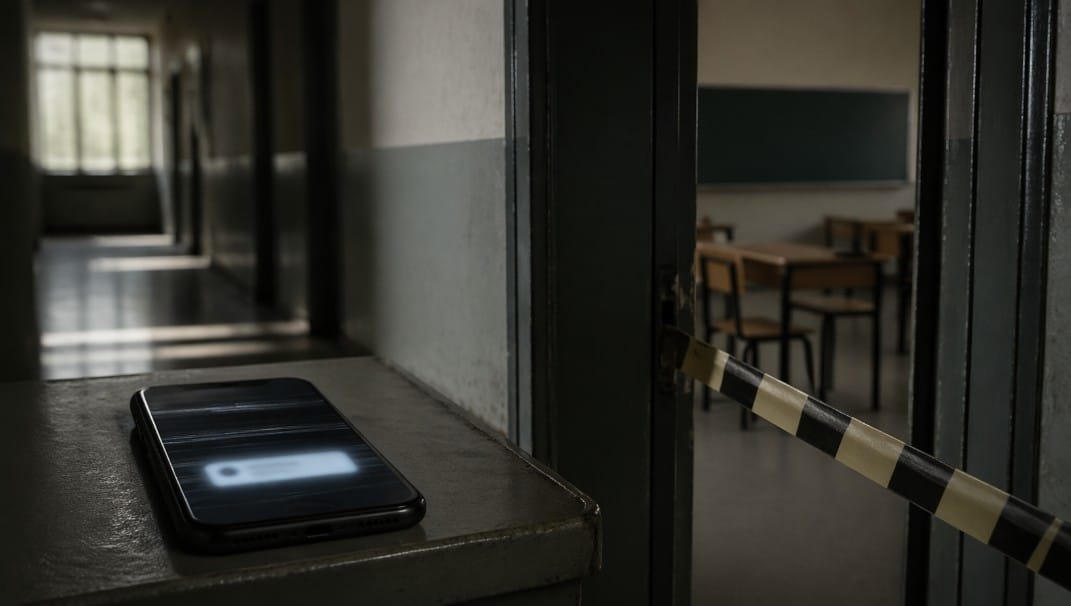
After the school attack in Kahramanmaraş, the state acted fastest in the digital sphere: thousands of access blocks, detentions, a broadcast ban. But the question of which information was silenced and which was allowed to circulate remains unanswered.
On the investigation, digital intervention and the limits of public information
After the school attack in Kahramanmaraş, one of the state’s quickest reflexes was directed at the digital sphere. According to a statement by the General Directorate of Security (EGM) on 17 April, access was blocked to 1,866 URLs, 307 account administrators were identified, 411 people were apprehended and 111 Telegram channels belonging to a group called “C31K” were shut down. A separate EGM tally released a day earlier had announced action against 940 social media accounts and 93 Telegram groups. In other words, the attack was followed not only by an investigation and administrative oversight but also by a broad, steadily expanding line of cyber intervention.
Some of these interventions are, of course, based on a clear and urgent security need. Official statements refer to content that praised the perpetrator, called for new attacks or aimed to spread panic. Up to this point the line is clear. C31K, short for “the 31st Level of Hell”, was a structure that had previously made headlines in connection with the murders of children, operated with more than 100,000 members, openly declared the attackers “heroes” after Kahramanmaraş, shared dates and locations for new school attacks and distributed a priced “crime tariff” to its members. This was not an ordinary social media post; it was an organised and concrete threat, and it had to be shut down.
But where was the limit of this intervention drawn? Did all 1,866 URLs contain open threats, or did questions and information that contradicted the state’s official statements also end up on the list? The public does not know. The broadcast ban was imposed on the grounds of “the integrity of the investigation”. This justification may be seen as legitimate. During the same period, however, 12 people were detained over posts about the incident and 7 of them were arrested. The charges in this case were not limited to “provocative posts”. Publicly insulting a public official, inciting the public to hatred and hostility, publicly disseminating misleading information, violation of confidentiality and “denigrating state institutions” under Article 301 of the Turkish Penal Code were also among them. Where the line is drawn between an open threat of the C31K kind and harsh public criticism of the incident is therefore extremely important. And this line was not disclosed to the public.
What Lies Outside the Father’s Statement
What is truly disturbing here is not that information stopped flowing altogether, but that it flowed selectively. While the broadcast ban was in force, some fragments of statements attributed to the perpetrator’s father found their way into the media: accounts that his son had psychological problems, was receiving treatment and had recently neglected his treatment were widely shared. Reuters also reported that a preparatory document dated 11 April had been found on the perpetrator’s computer. The issue is therefore no longer simply that “information was concealed”; it becomes a question of which information was, in practice, allowed to circulate.
This is also where the case’s centre of gravity shifts. When the father’s psychology-focused statement comes to the fore, the debate can easily be squeezed into the frame of a “family tragedy”. Yet the material thread that is now public and strongly verified points to something weightier: there was a dated preparatory text on the perpetrator’s computer, and those around him did not report the attack announcements on Discord because they took them for “black humour”. It is also alleged that the father’s influence prevented a self-harm incident from being entered into official records. This chain points to something larger than an individual drama: at each link of access, reporting, supervision and institutional response, who saw what, and who failed to do what?
The Question That Entered Parliament, the Answer That Will Come Out of It
After the attack, a quick political reflex emerged in parliament. With the joint agreement of all political parties, it was decided to set up a parliamentary inquiry committee. On 18 April, Speaker of Parliament Numan Kurtulmuş said plainly: “A very serious inquiry committee must be set up quickly.” This shows that there is a demand for a committee at the level of political will. That is a good sign. But what the committee will not ask matters as much as what it will ask. The question of metal detectors at school gates can easily make it onto the committee’s agenda. On the other hand, standards for storing guns at home, the regime governing access to firing ranges and weapons for the children of state personnel, and the allegation that a mental health record was concealed through institutional influence could just as easily be left off it.
Added to these developments was President Erdoğan’s statement of 20 April: stricter gun ownership rules would be introduced, heavy sanctions would be imposed on gun owners if children gained access to their weapons, and internet controls would be increased. A promise of regulation is one thing; which concrete institutional failures that regulation will target is another. Erdoğan’s statement addressed safety standards for guns at home. But was a special oversight mechanism for the children of the state’s own security personnel also discussed? Or will it be?
When I began writing these lines, the question I asked myself was: who is trying to close this file? Now I can ask the question more precisely: into what narrow frame is the file being squeezed? If we look only at the shutdown of provocative channels and the large numbers of blocked sites, the matter may seem resolved. If we look only at the father’s psychological account, it can be reduced to an individual family tragedy. If we look only at the promise of new legislation, we might think institutional accountability has begun. Yet public responsibility should settle for none of these. Unless the entire material chain that the investigation brings to light is kept open, this file will not be closed or solved; it will merely have been narrowed.
Sources
Monthly · free
Compass of the Month
Once a month: five points from Europe’s security and migration agenda and the month’s PUGAT articles, in your inbox.
Newsletter sign-up opens soon.
Read next

What is PUGAT? A non-profit community publishing independent analysis from Europe on security, migration and society in Turkish, German and English.
Go to the homepage
